


 Artist: Georgina Andrews
Title: Fetal Imprints
Medium: Acrylics on canvas
Contact: 0477 447 6693
FEATURE ARTICLE
Environmental Responsibility
Seems like a big call, to take responsibility for the environment, I mean, it’s HUGE! Isn’t it?
What is ‘the environment’ anyway?
If you are an ecologist, you might say that the environment is the natural heritage of the planet; forests, rivers, trees, the atmosphere, the oceans and so forth. If you are a geologist, you may say that it is the elements deposited over millions of years, upon which all biological life forms depend. If you are an anthropologist, you might describe it as the surroundings in which a people are, or were, situated. If you are a sociologist, you might say that the communities and infrastructure that animals and especially humans build constitute ‘the environment’. As you can see, if we are looking for a definitive answer to our question, we are likely to be disappointed. And, without knowing what the environment actually is, how can we take responsibility for it?
 I would like to suggest a partial solution to our conundrum. Instead of trying to define what the environment ‘is’ and getting ourselves into endless fruitless arguments, we could look at what effect we seem to have upon the various types of environment, which are being explored through the different lenses of the various sciences and academic disciplines. Instead of trying to put facts and figures on the agenda, we could take a lens more akin to the one used by the shamans throughout the ages. We could consider that the world in which we live, our environment, is also very much alive, and that it responds to our direct and intentional influence. If we begin from this position, there is a good chance we will be able to see where the potential for one person’s contribution to benefit the ‘environment’ can be realised.
We can begin close to home, in the environment of our thoughts and feelings, our inner environment. There is good scientific evidence that our thoughts and feelings are broadcast all around us and affect other living, and non-living things. The way we choose to express ourselves in any given moment has flow-on effects to everything in our immediate environment. The sounds we make, the emotions that we either act out or repress, and the movements of our physical bodies, all these are amenable to conscious control. When we are feeling good, and perhaps making a little voice music, or dancing around, we infect those around us with an uplifting energy. We add positive vibrations to the environment in this way, benefiting those who are around now, and those who are yet to come. An environment that has been infused with happiness will uplift everyone who enters. Needless to say, the opposite also applies, and without dwelling on the negative, we can use this understanding to see how wars and conflict affect whole regions and populations for generations.
Now, if you are thinking that one person’s influence is inconsequential in the overall scheme of things, you might be looking at too big a picture. No one of us alone can mitigate climate change, or prevent war from erupting on the other side of the planet. However, each one of us can hold in our hearts a positive vision for these things to be resolved, each of us can choose to believe anything actually, so why choose to believe a story with a grim outcome? Once we realise that each bit of influence adds toward a larger and larger influence, and we act accordingly, things in the world do in fact begin to change. With a belief in positive outcomes, we are inspired to enact them – look at all the trees we are planting for instance. What I am advocating is the exercise of free will, the CHOICE to believe that good outcomes are possible and the willingness to directly engage our environment, natural, built, and energetic, in a loving and compassionate, responsible manner.
If we are aware and responsible in ways that improve our immediate environment, we set up the possibility for others to do so too. When we create these openings for others to step into, we are doing our bit and taking responsibility for the environment, directly and effectively. We set up our future through what we do now, and everyone yet to come reaps the legacy – food for thought.
Grace Clarity
REGULAR FEATURE
Herb of the Month
GRAPEFRUIT:
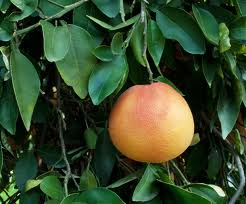 Continuing with the definition of an herb as any plant food that can be also used as medicine, this month we are celebrating grapefruit. One of my lovely yoga students has an extremely abundant tree of the ruby red variety, and I’ve been lucky enough to drink ‘fresh from the tree’ grapefruit juice most mornings for the last few months.
I’m feeling fresh, energised and have lost about 3-4kg since then (but I’ve also been taking pole-dancing lessons! So that could be what’s getting me in shape). Let’s have a look at the reported benefits of grapefruit.
Drinking the juice like I did, can be good for high cholesterol (because of the pectin), prostate cancer (because of the amino acid lycopene), as well as other plant chemicals that protect against cancer and inhibit tumour growth. Skin conditions such as psoriasis can be benefited and it can help you lose weight. Some people also find that symptoms of inflammatory conditions such as arthritis and lupus are minimised when grapefruit is regularly consumed.
An extract of the seed is also commonly used as an oral herbal supplement for bacterial, viral and fungal infections, including Candida. Grapefruit seed extract can be used on the skin as a toner, or as a douche to fight thrush. Using grapefruit extract may also benefit infections of the throat, nose or ears.
Grapefruit has a lovely, revitalising smell, and so as an essential oil, can alleviate mild depression and fatigue. One of my favourite blends is with jasmine; this makes a gorgeous uplifting perfume, (can’t believe I gave away my secret!).
 Nutritionally, grapefruit contains lots of Vitamin C, fibre, potassium, pectin, antioxidants, folate, calcium, iron and the ruby ones have beta carotene, which is a precursor of Vitamin A.
As a weight-loss aid, grapefruits have little calories, but are still high in soluble fibre and so fill you up, helping you consume less calories overall and thus lose weight. Dr Fujioka performed a 12-week study of the effects of grapefruit on weight-loss, and participants lost on average 3.6 pounds, with many losing up to 10 pounds by drinking grapefruit juice 3 times per day.
BUT, somewhat surprisingly, the humble grapefruit can have serious implications when consumed with medications. This is because grapefruit juice inhibits an enzyme in the intestines that breaks down and absorbs many medications, so the drug can reach a hazardous level in the blood stream. Particularly risky are blood pressure, cholesterol, anti-histamine and psychiatric drugs. Who would have thought?
For those not on medications, there is so much more you can do with grapefruit than eat half for breakfast or juice it. Try slices in a salad, added to Gin for a tangy cocktail or mix the juice with a dash of lime, a dollop of Dijon mustard, a scoop of mayo and some poppy seeds for a yummy salad dressing.
ENJOY radiant health with herbs.
By Ella Shannon. This article is NOT intended to diagnose, treat, cure or prevent any disease or illness. Trust your own intuition and seek professional advice when needed. Ella is a qualified Yoga teacher, Reiki Master and Addiction Counsellor with a passion for natural health and well-being, and is the proprietor of Port Douglas Happy Herb Shop on Macrossan Street. Phone: 07 4099 6313 wwww.happyherbcompany.com/portdouglas