


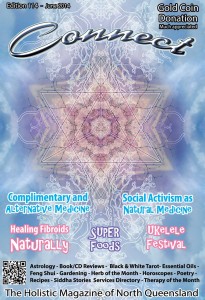
 COVER ARTIST: Boni Crystal
TITLE:
MEDIUM:
CONTACT: www.crystalotuscreations.com
Facebook: Crystalotus Creations
Boni is a freelance Graphic Designer and also has a shop at the Kuranda Original Rainforest markets with her artwork prints and handmade creations. Crystalotus Creations is the creative projection of Bonny Cooper (Boni) a multi medium creative creature who lives in tropical North Queensland. She works mainly with digital art and photography creating organic nature and cosmic inspired dreamings. .
Complementary and Alternative Medicine (often abbreviated as CAM) refers to healing treatments that don’t fit into Western conventional medical training.
Within the definition of CAM therapies, the term ‘alternative medicine’ specifically refers to non-conventional treatment modalities – such as Naturopathy or traditional Chinese medicine – that can be used instead of conventional medicine. ‘Complementary medicine’ refers to non-conventional treatment approaches used together with conventional medical treatment, to support (complement) conventional treatment. Two examples of complementary medicine are Reiki, and Aromatherapy.
Complementary and alternative approaches are very popular in Western societies, with 40 percent of adults overall reporting in a 2007 survey that they used some CAM approaches in addition to conventional medicine – which could mean taking vitamins and minerals, using herbal remedies, participating in yoga or meditation, having massages, being treated with acupuncture, chiropractics or Bowen therapy, among many other approaches. And 70 percent of conventional doctors and nurses surveyed said they used some CAM approaches! Increasingly, some medical doctors and also some hospitals and hospices in Australia are embracing CAM therapies, combining them with mainstream medical therapies. The terms ‘integrative medicine’ or ‘integrative healthcare’ refer to a healthcare situation in which a combination of conventional and CAM approaches is used.
The National Center for Complementary and Alternative Medicine (NCCAM) is a United States government agency that investigates complementary and alternative healing practices in the context of meticulous scientific methodology, in training complementary and alternative medicine researchers, and in disseminating information to the public and professionals. NCCAM has classified CAM therapies into five categories:
Whole medical systems
Mind-body medicine
Biologically-based practices
Manipulative and body-based practices
Energy medicine
Whole medical systems
Whole medical systems are not just a single practice or remedy, such as massage, but a variety of approaches based on a central philosophy of health and healing. An example of a whole medical system is Naturopathy, which focuses on non-invasive treatments such as remedial massage, nutritional and herbal remedies, exercise and lifestyle counselling, to support and assist the body’s own healing capabilities.
Mind-body medicine
Mind-body approaches are based on the understanding that the operation of the mind – for example a person’s belief systems – underlies physical and emotional ill-health. The aim of a mind-body therapy is to assist the mind and the body to be in harmony. Examples of mind-body techniques include meditation, hypnotherapy and music therapy.
Biologically-based practices
These treatments use ingredients found in nature, including dietary supplements and herbal remedies. Examples of herbs used are ginseng, ginkgo and echinacea, while commonly-used dietary supplements include fish oils, calcium and vitamin supplements. Herbs and supplements can be taken as teas, oils, syrups, powders, tablets or capsules.
Manipulation and body-based practices
These methods use human touch to move or manipulate specific parts of the body. They include massage, and chiropractic and osteopathic manipulation.
Energy medicine
Energy medicine is a term used for healing therapies that are focused on manipulating the body’s energy – called in different traditions by different names such as chi, prana and life force. Energy medicine practitioners consider that illness can be caused by blockage or imbalance of the energy force; the goal of these therapies is to unblock or re-balance the person’s energy. Energy therapies include Qi Gong, Therapeutic Touch and Kinesiology.
The attitude of conventional medicine to CAM therapies
While many Western medical doctors do themselves use some CAM therapies, conventional medical training doesn’t include CAM therapies. Conventional medicine values evidence-based therapies that have been demonstrated through rigorous research and testing to be safe and effective. While scientific evidence exists for some CAM therapies, for many there are key questions yet to be answered.
So unless doctors have undertaken research or investigation of their own they are not qualified to make recommendation in this area. However, as the evidence for certain therapies increases, doctors are increasingly open to complementary and alternative medicine, and some doctors have undertaken training in areas of alternative medicine, to become holistic doctors.
A holistic doctor is fully medically qualified, as well as having training in one or more areas of alternative medicine. Holistic doctors look at the issues of health and disease from a holistic or ‘whole body’ perspective, treating not just the symptoms that a patient presents with, but underlying problems as well, using non-conventional approaches.
Why is there so little research into CAM approaches?
Large, carefully controlled medical studies that have scientific validity are costly. Trials for conventional therapies are often funded by big companies that develop and sell medicinal drugs. So far fewer resources are available to support trials of natural products or treatment procedures, which are the basis of many complementary and alternative therapies.
Considerations when using complementary and alternative medicine
Even if a doctor can’t recommend a specific practitioner, he or she can help you understand possible risks and benefits before you try a treatment, and can regularly monitor your medical condition. Some supplements and CAM treatments interact with or affect traditional medicines, so it’s especially important to involve your doctor if you’re pregnant, have medical problems or are taking prescription medicine. Keep your doctor updated on any complementary and alternative therapies you’re using, including herbal and dietary supplements. And don’t stop or change your conventional treatment – such as the dose of your prescription medications – without talking to your doctor first.
If you are considering using CAM approaches for the first time, particularly ingestive approaches or therapies that involve manipulation of the body, carefully consider your own health and any conditions you have that might be negatively affected. To help you make informed decisions regarding herbal medicines or dietary supplements, consult a qualified Naturopath rather than just reading the labels in the pharmacy, and also discuss your options with your medical doctor. With the assistance of good professional advice, a combination of conventional and alternative medicine can be an excellent approach to personalised health care.
Annabel Muis
REGULAR FEATURE
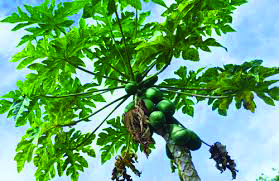
Relatively new as a popular herbal remedy, the leaves of the pawpaw tree have been used traditionally for thousands of years to treat digestive issues and parasites. This article discusses what we interchangeably call in Australia, either papaya or pawpaw: Carica Papaya. Not Asimina triloba, which is also referred to as pawpaw in North America, and also contains medicinal properties.
Pawpaw leaf contains vitamins A, B, E and C, zinc, manganese, iron, magnesium, calcium and potassium. It also contains the enzyme papain, which improves the assimilation of nutrients and improves the digestive juices. In fact papaya contains a higher enzyme content than any other known herb. This enzyme helps the body break down and digest protein, and also carbohydrate, which includes gluten, and has been found to help people suffering from Celiac disease and those who have trouble digesting starchy foods.
Further effects on the digestive system include getting rid of bacteria in the digestive tract that can cause stomach upset, and reducing inflammation of the stomach lining and colon, therefore being of possible benefit to people with IBS, gastric ulcers and acid reflux etc. A strong tea however, acts as a laxative, so unless this is the desired effect, keep to the recommended dose.
 Taking pawpaw leaf tea is also said to benefit those with benign prostate enlargement, reduce symptoms of menstrual pain and increase the appetite, and it can be used topically for skin problems such as acne, warts, scars and fungal infections.
Recently, pawpaw leaves have been trialled as a successful cancer treatment. In the 60’s, a 70-year-old man, Stan Sheldon was given five months to live, after specialists found that cancer had spread to both his lungs. He amazed doctors by using what he called an old Aboriginal recipe of drinking pawpaw leaf tea. After two months, specialists were astonished to find no trace of malignancy.
In a clinical setting, ten different types of cancer cell cultures were exposed to papaya leaf extract; the growth of the tumours was slowed in every case. Right back in 1976, researchers in the US, at the request of the Cancer Institute, studied about 3500 different plants for their effectiveness in treating tumours. Pawpaw was the most effective of all. They found that the same enzymes that were so effective in treating digestive issues also make it past the mouth and prevent and fight cancers. The enzyme in pawpaw, papain, has been found in clinical trials to eat away at the fibrous coating around the cancer cells, so your body can kill the cancer. If this interests you, there is a website called Pawpaw Research that has extensive information on how it fights cancer cells.
Pawpaw leaves can be purchased from herb shops, or you can prepare your own easily if there is a tree nearby. Just take a few medium sized leaves, cut them up as you would a cabbage, and put them in a pot with two litres of water. Let it boil and simmer down to half. Strain and then keep in a container in the fridge for up to four days. If it goes cloudy, don’t use it. The original recipe says to take three tablespoons three times a day. If you have some dried leaves from a herb shop, just make it like a normal tea; the papain enzyme is most effective at the temperature of a good cuppa. Too easy. Enzymes have pretty much no side effects; many people feel alert and even mildly euphoric if taking them on an empty stomach. However, pawpaw leaf tea should not be taken by those using Coenzyme Q10 or thyroid stimulators. As always, if in doubt consult a professional.
Wishing you abundant health and happiness.
Ella Shannon is a qualified Yoga teacher, Reiki master, and Addiction Counsellor with a passion for natural health and wellbeing, and is the proprietor of Port Douglas Happy Herb Shop on Macrossan Street. (07 4099 6313) This article is NOT intended to diagnose, treat, cure or prevent any disease or illness. www.happyherbcompany.com/portdouglas