

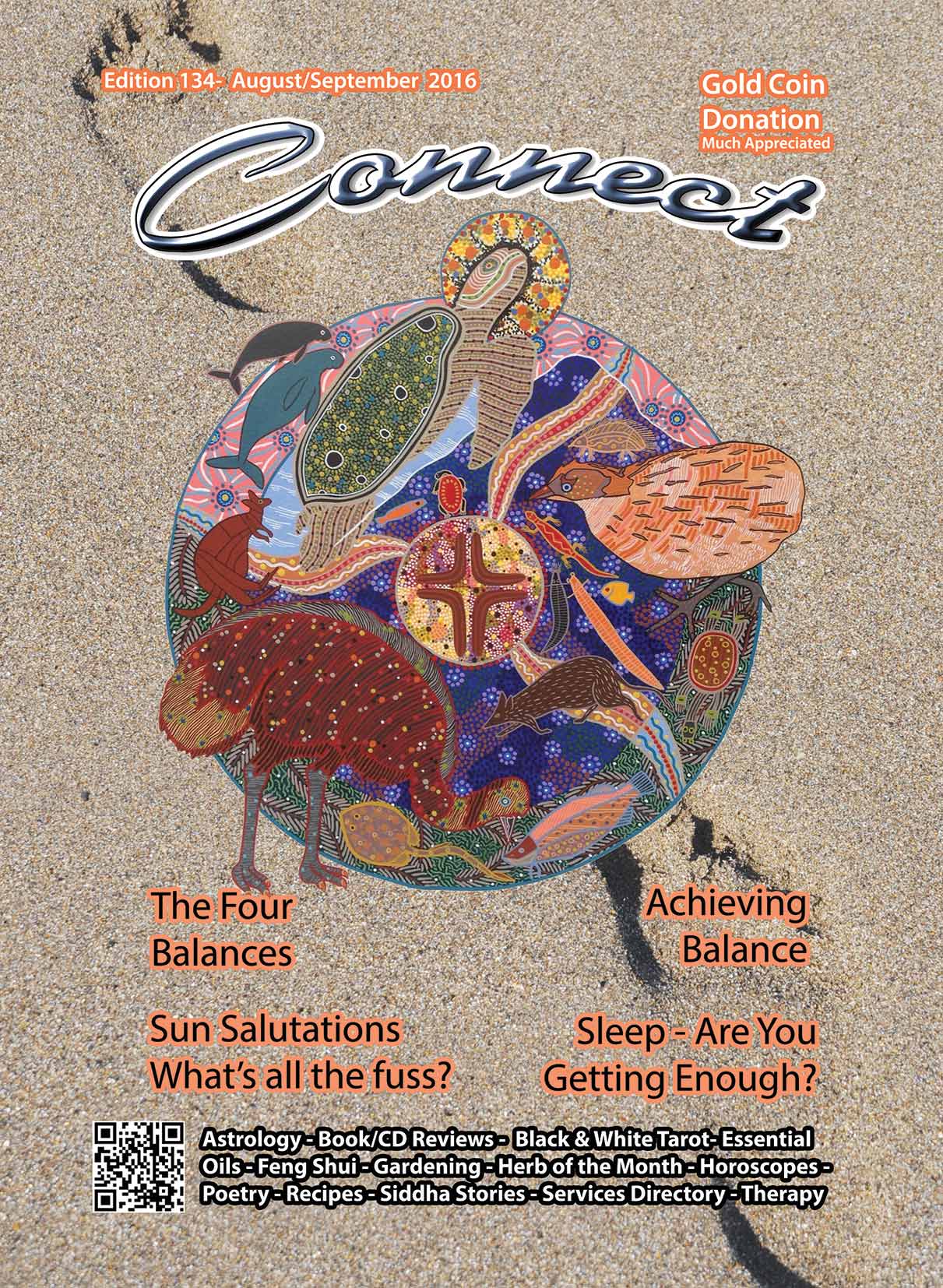
 Cover Artist: Zane Saunders
Title: ‘Wontulp Bi Buya’
Medium: Acrylic on canvas
Contact: zane@zanesaunders.com

When you were a child did you ever try to stand in the centre of a seesaw while two other children moved up and down at the ends? If you did, you might remember that it took a little while to get your balance, but once this was achieved it was possible to stand almost still, using just a little leg movement, even while the other children seesawed. Maintaining balance in life is a bit like being on a seesaw; however, instead of just two positions going up and down, there are several, and we must work at balancing each position in relation to all of the others.
A reasonable balance between all of the areas of our lives – work, family life, physical exercise, recreation, social and relationship activities, spiritual pursuits, learning and self-development, rest and sleep – is an important contributor to achieving physical, emotional and spiritual health. Conversely, prolonged periods of imbalance eventually lead to physical, emotional or spiritual dis-ease.
Certain aspects figure more prominently during some life stages than during others, so ‘balance’ will vary some, depending on your current age and life circumstances. It is important, however, not to focus too heavily on some aspects to the point that other areas are neglected. The consequences of this might become evident only after a long time, even years.
For young adults the focus can predominantly be on work and establishing a career, on social and relationship activities, and for some who have had children early, on parenting. The potential for competing priorities during this phase is great, and exercise, rest and sleep are often sacrificed. Fortunately, young adults are physically resilient and can handle such physical stresses for limited periods, but long-term neglect will eventually lead to physical and emotional depletion.
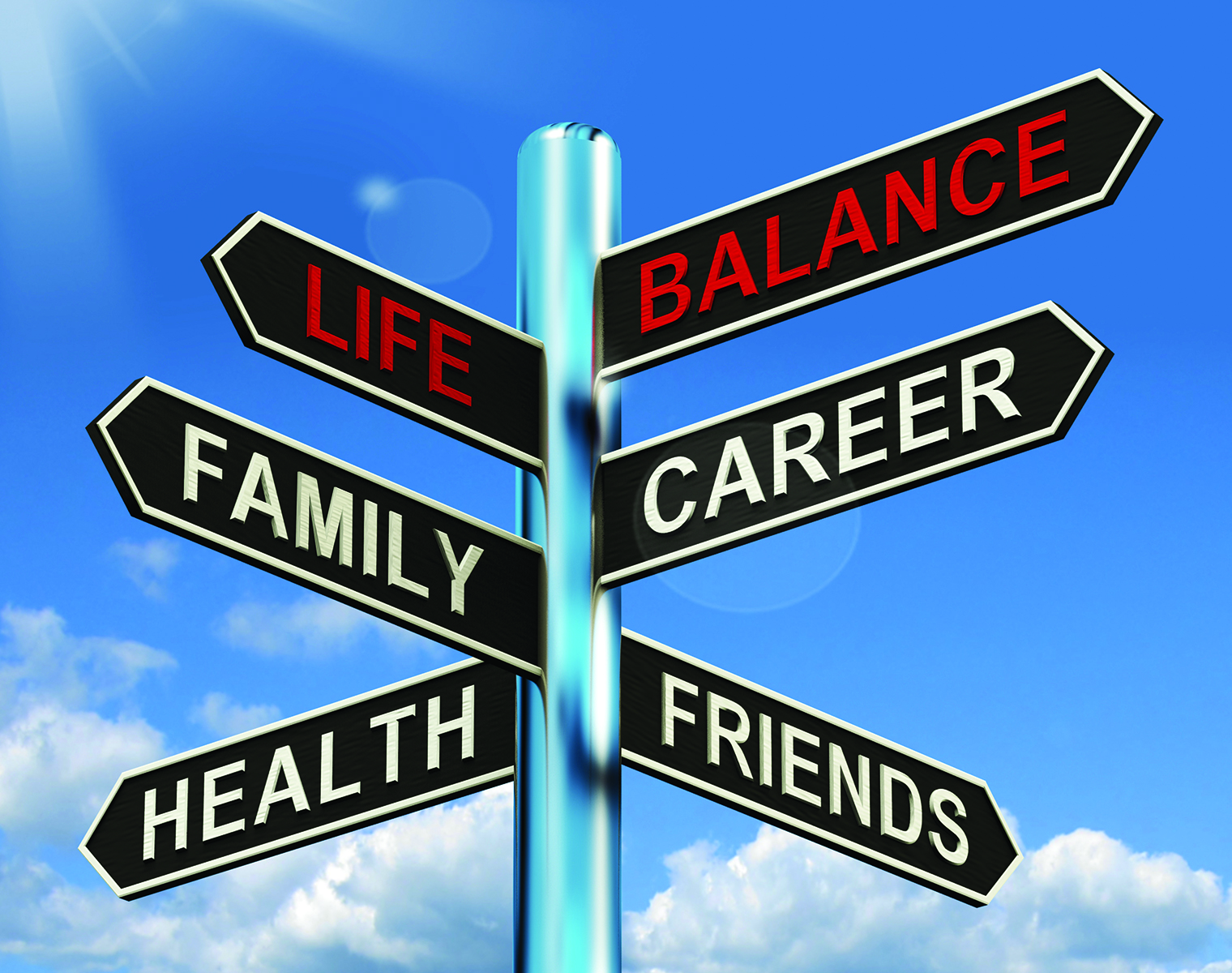
By mid-thirties the main emphasis tends to be on career and family. Work can make many demands on one’s time, particularly for those seeking to move ahead in their career. People of this age often also have young families, and combining career and family can pose differing challenges for men and for women. Although many fathers take a much more active parenting role nowadays than was common a generation or so ago, mothers can still find themselves trying to juggle a career, family, and a social life, often at the expense of their primary relationship and their sexual energy. For many men family life suffers while they are busy building a career, working long hours and socialising with friends. Our high rates of separation and divorce are a consequence of such imbalance.
By the time we are in our late forties family responsibilities may have lessened, and work and career can become less important, particularly if it seems that one has just about reached one’s peak. This is a time when some people realise they have neglected their most important relationships, and seek to establish a deeper connection with their partner and children. This can be the beginning of a more emotionally satisfying period of life; however, for some, their partner and/or children have established their own independent lives and no longer desire the same thing.
By our late fifties we can no longer take physical health for granted, and health and fitness might become the focus of our attention. Children leave the nest, and we begin to seek other satisfying ways to fill our time. During this phase the emphasis can shift to learning and self-development activities and to spiritual pursuits; people begin to question the meaning of their life and where it is heading.
The sixties and early seventies are for many people the time when they leave full-time work. If they haven’t spent time earlier in life building a wide network of friends and establishing satisfying non-work activities life can feel very empty. Physical illness is more likely to occur in individuals who are lonely and depressed, since our emotional state has an impact on our immune system.
At whatever stage of life you currently find yourself, it is worthwhile to take some time to evaluate the balance in your life right now. A week contains 168 hours – no more and no less. On average, we spend about 50 of these hours in bed; this may vary, but it will still be a sizeable chunk of your week.
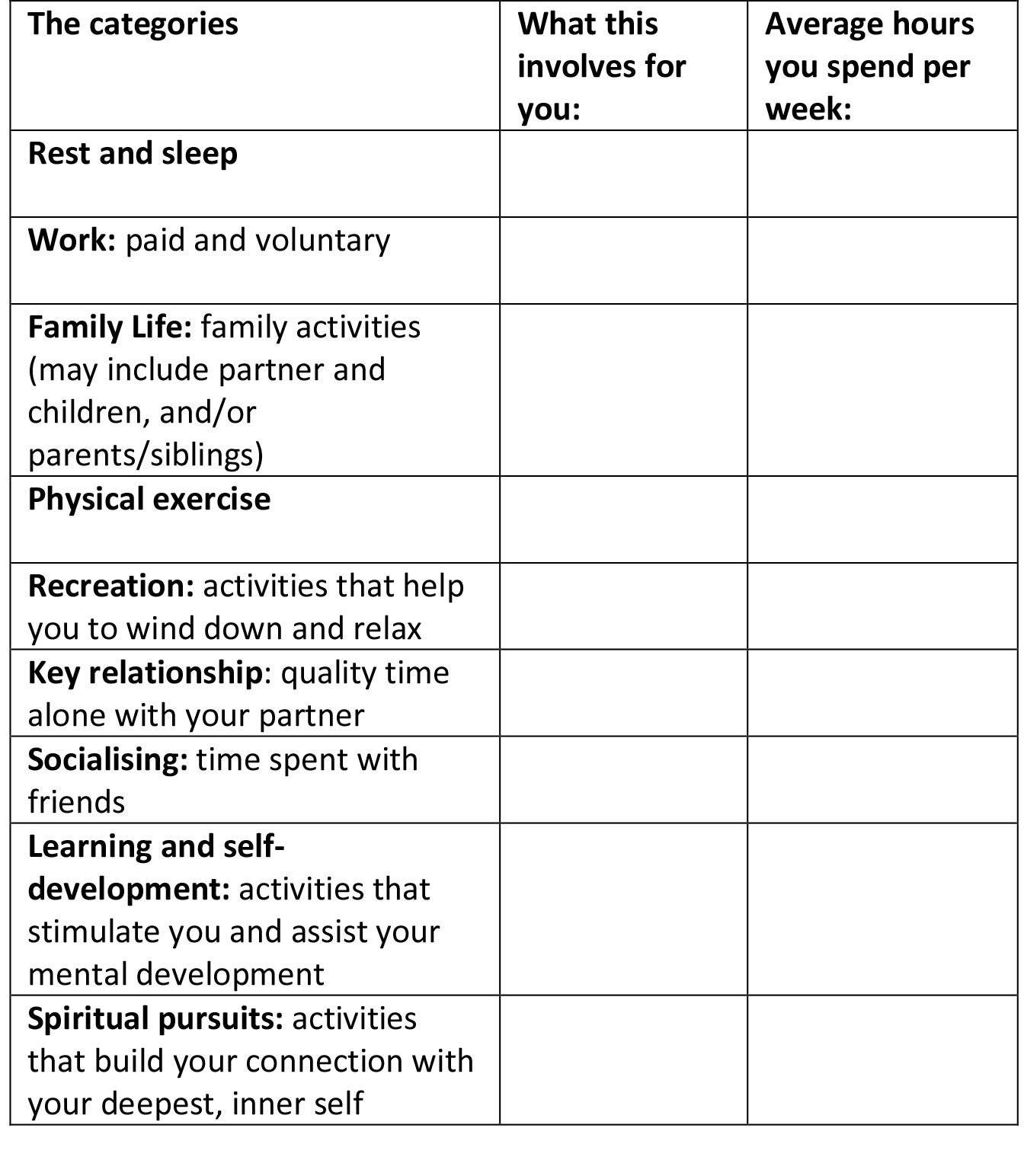
Below is an exercise you can use to assess the current balance of your life. This isn’t a test; it is a self-awareness exercise. Only by giving yourself an accurate look at the current balance in your life can you decide if any change would be of benefit.
Using the table below, record what you do for each category, and estimate the average time you contribute per week to each. This will differ according to your life stage, and some of the categories might overlap, e.g. physical exercise, recreation, socialising. The aim is simply to enable you to determine if there is any obvious imbalance and, if so, to consider how you might address this. By aiming for greater balance you will be setting the scene for a healthier and more rewarding future.
Annabel Muis a Reiki master/teacher living in Kuranda. Contact: E: annabel.muis@gmail.com Ph: 07 4093 8937