


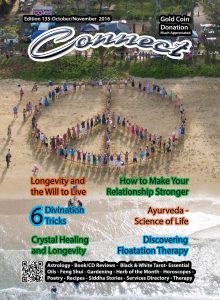
 Title: People’s Peace Sign
Palm Cove 2016
Medium: Aerial Photography
Contact: Event Organiser
Renee Cashman 0428 846 799
Thank you to everyone who came and co-created a fabulous Peace Day along the Esplanade at Palm Cove. The people’s peace sign was created by approx. 120 people to show that they are dedicated to building peaceful communities. May we all find peace in our hearts, peace in our homes, peace in our communities and our world.
It is common these days for people to place great importance on their longevity. The natural instinct for the preservation and extension of life can be regarded as a top priority. Thus one of my favorite singers, the long-lived Tony Bennett, said that longevity, rather than passing fame, is the thing to aim for.
Many people take considerable steps to try to ensure that they have a long and healthy life, free of trials and difficulties as much as possible. There are many recipes for achieving this. George Burns placed most importance on avoiding worry, stress and tension; others follow other routes. But one thing is for sure, this human life is only temporary. In fact, compared to the total time span of the universe each person’s life span is extremely short, almost insignificant.
So how are we to measure the importance of longevity? To live long but with many trials and difficulties is not seen as a desirable thing and yet the very nature of this human life entails trials and difficulties. It is inherent in the physical condition, as the Buddhist writings make clear. Shoghi Effendi wrote: Physical pain is a necessary accompaniment of all human existence, and as such is unavoidable. As long as there will be life on earth, there will be also suffering, in various forms and degrees.
So of course we should look after the body. The real question relates to the purpose of this physical life and why we should look after our bodies. Is it just to live a few months, a few years longer? Or is there a greater purpose? On these questions the great religions have a lot to say. They even require us to reconsider the very meaning of the term ‘longevity’.
From these questions arise the issue of the real nature of the human condition. Is it merely a physical purpose, to live each person’s very short allotted span of life and then to die and soon be forgotten? This view seems rather meaningless and, in my view, somewhat ridiculous. Is there a much great reality, a spiritual reality, in which every person potentially takes part? The great religions tell us that humans are essentially spiritual beings, made in the spiritual image of the one supreme deity (however called or described). The human body is depicted as the temple of the Divine Spirit. Thus 1 Corinthians in the New Testament states: know ye not that ye are the temple of God, and that the Spirit of God dwelleth in you?
As a spiritual being, the task of the human being is said to be to seek to know and to worship that one supreme deity. It is a task that applies in this world, but with benefits that carry over into the spiritual world after physical death. Union with the Divine Spirit is to be achieved in this world by living the spiritual life and developing spiritually. This includes by virtue, services to humanity and in the advancing of human civilisation. These are the ‘fruits’ of this physical life, as spoken of in the Gospels when it is said: The purpose of life is to get certain results; that is, the life of man must bring forth certain fruitage. It does not depend upon the length of life. As soon as the life is crowned with fruition then it is completed, although that person may have had a short life. There are certain trees which come to fruition very quickly, but there are other trees which attain to fruition very late; the aim is fruit. If the tree brings forth its fruit young, its life is short; it is praiseworthy. How regretful it is that a man may live a long life and yet his life may not be crowned with success, like unto the cypress tree which does not give any fruitage.
Thus it is not the length of a person’s physical life that is most important, but what the person makes of that life. And the quality of that life affects a person’s spiritual longevity. Cobb writes: Nothing earned without effort – this is the universal motto, this is the law on which the universe is run. Applying this law to the doctrine of a future life, one comes face to face with this astounding truth, that immortality has to be earned! It is not a quality inherent in this earth life, nor a gift lightly laid at the feet of all who die.
And the Tao says it all: ...he who dies and yet does not perish, has longevity.
Graham Nicholson, Hidden Words Bookshop, Kuranda, phone 4093 7120