

 Cover Artist: Peter Grimes
Title: Two Friends
Medium: Acrylic Painting
Website: www.petergrimescelticart.net
Feature Article – Develop Your Friendship Quotient
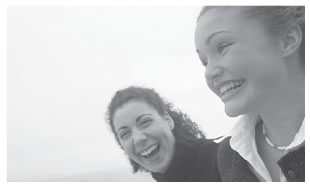
As I do, many of you probably receive a fair number of unsolicited emails about friendship, often with requests that the emails be forwarded to all those whose friendship you value, including the sender. This whole process can be irksome due to the volume as well as to the ‘schmaltzy’ quality of much of what is sent.
However, the fact that so much of this occurs indicates that friendship figures highly in the thoughts of many women. I say women simply because such emails most often come from women; men tend to communicate their interest in and express friendship differently. Nevertheless, a desire for friendship is a widely felt, and often unsatisfied, need.
If you asked yourself, “When I feel really down, how many people can I think of that I could turn to who would really listen to how I’m feeling, not secretly judge me (even if I am being irrational) and not gossip about me to others or try to tell me, unasked, what I should do?” how many people could you name? If the answer is three or four you are very fortunate; and this is quite likely more than many people could identify.
I spent many years working as a social worker in a variety of fields. One of the characteristics that stands out about the many people that I had contact with through my work was the widespread incidence of loneliness, and it seems that I see this in almost every area of my life even now. So many people seem to be experiencing a lack of ‘real’ human contact—including even some who have partners, children and quite a few people with whom they meet regularly.
A fundamental truth is that humans share a profound and largely unconscious sense of separation, which we try to resolve in many ways, including through our relationships. It is a desire not to feel separate that we seek to fulfi l through friendship.
Most of us have some or many acquaintances – people we meet through work, activities, clubs etc – with whom we pass our time in specifi c circumstances, but who would not fi gure among real friends as described in the earlier paragraph.
There is one key thing you can do to develop your personal Friendship Quotient (FQ) and along the way attract your share of real friends. The key is: Be the friend you would like to have. What does this actually look like in the flesh?
Following are somethings we can do to increase our FQ.
Learn to listen well.
In my teenage and early adult years I was very shy and felt totally out of my depth in social situations. I was virtually tongue tied when I was around people I didn’t know well. My silence led to me being labelled frequently as ‘snobbish’, but eventually I discovered the magical power of listening.
Being a good listener is a great way not to feel lonely in a crowd of unfamiliar people. Just look around for someone standing
or sitting on their own, go up to them, ask them something about themselves, and you can generally leave it to them to carry the conversation.
To be truly listened to is wonderful: it says to us, “You are so special that I’m willing to give you my time and full attention.” Truly listening means just that—seeking to hear and understand exactly what another person is trying to communicate, however inept their attempt, and however different their views are from yours. You don’t have to agree
with them; just listen, and let them know that you’ve understood.
Reserve your judgment.
A basic human need is to be accepted unconditionally. Inside every nasty, bombastic, critical, complaining, judgmental, attention seeking, over-talkative or just plain irritating person is someone who desperately wants to be liked for who they are—to be loved in fact.
Try to ignore the façade – this is just the shell they put on to protect themselves from possible rejection – and speak to the real person inside. It feels beautiful to make such contact—a real connection between two real people.
And if you sometimes fi nd yourself feeling critical of someone else’s behaviour, just recognise and acknowledge this to yourself, then forgive yourself and them for not yet being perfect!
Let go of your expectations.
As a young mother I spent a year alone while my husband (in the regular Army) was serving in Vietnam. I discovered that some people, whom I had thought of as friends and from whom I expected support during this difficult period, were not there when I sought their help. But others, some of whom I had barely known prior to this time, were there in ways that I never imagined or anticipated.
There is a limit to how many true friendships we can sustain. We need to recognise our own limitations in this regard, not feeling that we must put our own needs aside and always be there in service to others. It’s good to be clear with others about your own boundaries if they seem to want more from you than you can comfortably offer.
In the same way we must allow others to be the judge of their own ability and willingness to respond to our needs. We will have many acquaintances and if we are fortunate, a few good friends. Be grateful for true friendship wherever you find it; try not to condemn those who don’t give you the friendship you hoped they might; and be the best friend you can within your own limits.
By Annabel Muis, Reiki Master / Teacher
Regular Article – Generosity

Once there was a noble cavalier who loved a beautiful lady.
After he married her, another cavalier courted her secretly,which she abominated, but she dared not tell her husband of the intrigue, lest there be bloodshed.
Tarolfo, the second nobleman, troubled her so much by letters, flowers, and small gifts of love, that the lady told him she must see him. He arrived at a hidden bower, feeling that he must surely have won her. But he was in for a surprise.
“My good sir,” said she, “there is only one situation in which we can be lovers. When my garden shall bloom in cold January with flowers of mild June.”
“I swear that I shall not rest until I have learned how this can be done, dear lady,” said he, leaving with his head high.
“That shall never be,” said she, and went to her boudoir, secure in the belief that she would not see him again.
But Tarolfo went to Thessaly, where he chanced upon an ancient man, gathering herbs in a dark wood. “What do you do, Sir?” he asked the old man, and the answer was, “I am collecting for physic. Who are you and what do you here?” “I am from the farthest West, I grieve over a most hopeless position, yet I have still hope, for the prize is very great,” said Tarolfo.
The old man, who was called Tebano, said, “I will help you if you tell me what it is that you have to do.”
The cavalier told him, “I must make a garden blossom in January with all the fl owers of summer.”
“It can be done,” said the old man. “Do you not know this is an uncanny place you have come to?”
“God will protect me,” said the nobleman.
“Do not judge me by my outside appearance. I can do anything that is required, if the payment is right. What will you give me if I perform this service for you?”
“You shall have half of whatever I own, half of my horses, half of my sheep, treasure, and houses,” promised Tarolfo, so
eager was he to gain the love of the lady.
The magician agreed, and they went to the garden in January, on the night of a full moon. With mystic movements and
strange utterances, the old man cavorted around the garden. By dawn everything was in fl ower as if it were midsummer. Roses and fair blossoms were everywhere.
“By my faith,” cried the lady, upon rising, “the garden is blooming with every fl ower of summer. I am undone!” Nearly out of her mind with distress, she sent him a letter to say that she must wait until her husband was away from home.
Now her husband, loving her much, noticed that she neither smiled nor ate for the space of a week, and questioned her. “Is
it your health, my love, or your mind?” he asked anxiously. Unable to bear the shame, she told him everything, and waited for his condemnation.
It did not come. Instead he said gravely, “You made a promise, even though it was a rash one, but as you are bound by
your word, you must keep it. You should go to him, but, my dear, do not in future make any promise such as this – even though it does seem impossible.
“You mean I should let him enjoy me as he wishes?” she cried.
“Yes,” said he, “Tarolfo has earned his reward. He has kept his word, now you must do so.”
With her maidens around her, she sadly went to meet the cavalier at the appointed place. All adorned she went, yet her
heart was heavy and she dreaded his approach.
“Does your husband know?” was his fi rst question.
“Yes, he sent me to you so that I should keep my word,” she replied.
Tarolfo thought for a moment, then he said: “Please return to your husband. He is so generous a man that I cannot take
what is rightfully his.” A look of shame came to his face. “Beg him to forgive me, I will never do anything so ignoble as this again.”
She thanked him and returned to her husband, full of joy.
Her lesson had been hard, but she had learned it.
Now, the magician, when Tarolfo went to him and said,
“Come, take your half of my possessions,” was not pleased. “I cannot take payment for what has not been a successful enterprise,” he said, shaking his head. “I have pride in my work. After all, am I not a craftsman just as any carpenter or builder? The gods forbid that I should be less generous than the husband has been.” And he disappeared before Tarolfo’s very eyes.
Now, which of the three was the most generous?
The Universal Storyteller