

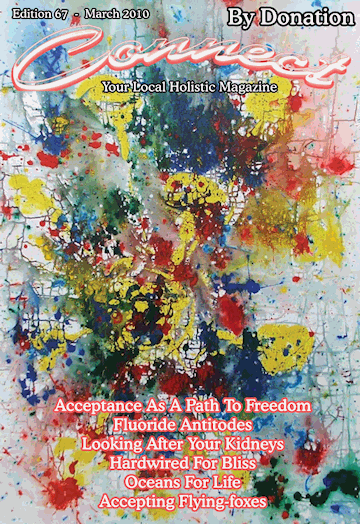
 COVER ARTIST: Jane Leadley
TITLE: Divine Intervention
MEDIUM: Oil and Acrylic
CONTACT: alcheringa98@hotmail.com
Feature Article

Acceptance is probably the most profound healing tool we possess. We need no special training or knowledge to utilise it; it doesn’t require us to be smarter than average or even more insightful. And it costs nothing. Yet more often than not in this modern world it’s the last tool we would think of using. We are taught that if we find something uncomfortable, if we are experiencing physical or emotional pain, we can medicate it away. Sadly, by doing so we are turning our backs on the greatest source of wisdom we have: ourselves and what our bodies are trying to tell us. And of course the pain remains, it is simply being masked.
Which is OK really if we have a headache. But what if our headaches are chronic and persistent and just won’t go away? How do we address any underlying issues that trigger these episodes? If we can just allow ourselves to accept that we are in pain and that there is a good reason for that pain, perhaps then we can start to listen to what our body is trying to tell us – a case of ‘now that I’ve got your attention…’ The language of our bodies is symbolic and it never lies. It is constantly trying to communicate with our ‘rational side‘. Sometimes it really has to work hard to get us to acknowledge we have a problem at all (we all have a bit of Cleopatra in us). It can feel so much easier to deny that we even have a problem – or conversely we might find solace in ‘wallowing in it’. How much more we become though, when we choose to observe and respond to the reality of our circumstances.
It the western medical model we have in Australia, we become used to the language of dis-ease. Viruses ‘invade’ our bodies; these are ‘attacked’ by our bodies’ immune systems; we are told to ‘fight’ our disease (particularly when it manifests as something serious such as cancer) and we ‘win’ or ‘lose’ our ‘brave battle’ with the illness. We must not ‘give in’ to our depressions and anxieties. People talk of ‘hating’ what their disease is doing to them, “It’s an obscene illness.” Such language – as if we are at war with our own bodies. And so much of our energy is exerted on ‘the battle’ when what we need to learn is to treat ourselves and our bodies so much more kindly and gently. It is not our body’s fault that we are sick. We are in a state of imbalance and that is down to us to remedy.
 By being able to accept our situation we are in fact making peace with our lives and ourselves – and this can be an immense relief. When we are finally able to accept ourselves and our situation we can stop the eternal to-ing and fro-ing within our minds and bodies. When the inner battles cease we have access to all that energy, energy we can pour into our healing and wellbeing.
Buddha taught that we experience pain and suffering (misery) whenever our minds are out of sync with the reality of our lives – when the way we want our lives to be is in collision to the way things actually are. The pain then is just a wakeup call. Whether we choose to continue sleepwalking our way through life or respond to the reality of our problems is down to us. The former does nothing to deal with the pain. The latter happens when we decide it’s time to take control of our lives ourselves. The responsibility for our emotional wellbeing lies in our own hands. The steps we need to take to achieve this are small ones. We can start with simply being mindful of our body and its responses (or observant if you prefer).
The Mental Health Foundation (UK) recently recommended that ‘Mindfulness Meditation’ be used far more extensively for the treatment of conditions such as chronic pain, anxiety, stress, depression and addiction. This is in light of clinical studies that have proven its efficacy in helping people to change their relationship with themselves.
And there are other healing modalities, which can help with this process too. Any form of energetic or spiritual healing will help to identify and resolve the underlying imbalances that have caused our body/psyche to manifest disease. We are lucky in Cairns that we have such a variety of healing practitioners. Acupuncture, reiki, homoeopathy, spiritual counselling, EFT to name a few, all have a very important role to play in helping people achieve balance and wellbeing. Not everything will be suitable for everyone. But your instincts will tell you which is right for you; just be still and listen.
Pain and suffering can be our greatest teachers – character is forged in adversity… By changing the way we think and feel about our problems, whatever they may be, we might just find that the journey becomes an adventure and that a state of acceptance is the most empowering space to be in, and the best one to make the changes our bodies and psyches have been pushing us towards.
Jill Richardson is a reiki practitioner, counsellor and sometime tarot reader (for counselling purposes). Please ring 0422 692 052 for info/bookings.
Regular Article

In the land which is unseen to us, but in reality more real than the real, there lived a boy, and his name was Kasjan. His elder brother Jankas was hard-working and intelligent. But he, Kasjan was neither hard-working nor idle. He was neither intelligent nor stupid, but he used to apply himself to any problem he could, as well as he could.
The two brothers, neither of whom seemed to be making any progress in the Unseen Land, decided to seek their fortunes together. They walked away from their home one afternoon, and it was not long before darkness separated them, and …as for Jankas we shall hear presently. Kasjan came suddenly upon a quarrel. Three men were arguing, it seemed, about three items lying on the ground. They explained to him the trouble. Their father had died and left them a conical hat, the Kulah of Invisibility, a flying carpet, and a staff which made the carpet fly when it was beaten with it. Each one wanted all the items, or at least first choice of them. Their reasons were that they were the eldest, the middle and the youngest sons, and each on this account claimed priority.
They are all unworthy, thought Kasjan, but he offered to adjudicate between them. He told them all to withdraw forty paces and then turn round. Before they could finish his instructions he had placed the Kulah on his head, got on to the carpet and struck it with the stick. “Carpet,” he commanded, “take me to wherever my brother Jankas may be.”
Now not long before, his brother Jankas had been snatched up by a mighty Anqa bird, which had deposited him on the minaret of a mosque in Khorasan. Because Kasjan was thinking at the time, however, that Jankas must have made himself a prince at least, the carpet heard this thought and – flying with immense speed – came lightly to rest on the battlements of the king’s palace of the city of Balkh in Khorasan.
The king, who had seen him alight, came out at once, saying, “Perhaps this is the youth who it is foretold will help my daughter and yet not desire her.”
Kasjan saluted the king, and told him that he was seeking his brother Jankas. “Before you do that,” said the king, “I want you to help me with your special equipment and keen mind.” The princess, it transpired, used to disappear every night and return in the morning, nobody knew how. This had been foretold and had come to pass. Kasjan agreed to help, and suggested that he should watch by her bedside.
That night, through half-closed eyes, he saw the princess look to see whether he was asleep. Then she took up a needle and stuck it in his foot, but he did not move, because he was expecting some such thing. “I am ready,” said the princess, and all at once a terrible spirit appeared and took her on his shoulders, and they soared together through the ceiling, without making any impression on it.
Rubbing his eyes, Kasjan immediately placed the Kulah of Invisibility on his head, sat on the magic carpet and, beating it with the stick, cried, “Take me where the princess has gone.”
There was a rushing and a roaring, and Kasjan found himself in the Unseen Land beyond the Unseen Land. There was the princess accompanied by the spirit. They walked through forests of trees of precious stones. Kasjan broke off a piece of jade tree with diamond fruits. Then they walked through a garden of unknown plants of unexcelled beauty. Kasjan put a few of the seeds in his pocket. Finally they stood by a lake whose reeds were shimmering swords. “These are the swords which can kill spirits such as me,” said the spirit to the princess, “but only a man called Kasjan can do it, so it has been foretold.”
As soon as he heard these words, Kasjan stepped forward, seized one of the swords from the reed bed, and cut off the awful head of the spirit. He seized the princess and dragged her onto the carpet. Soon they were speeding back to the palace of the king of Balkh in Khorasan.
Kasjan took the princess at once before the king, waking him unceremoniously from his slumber. “Your Majesty,” he said, “here is your daughter, and I have released her from the grasp of a demon in such-and-such a manner.” And he related all that had befallen them, producing the pieces of jewel and seeds as proof. Released at last, the princess offered to marry Kasjan. But Kasjan, asking for a few moments’ leave, flew on his magic carpet to find his brother Jankas.
Jankas was sleeping in a caravanserai, because he had only been able to obtain employment as teacher in a seminary, and the pay was very low. When they returned to the court, the princess was immediately smitten by the manly features of Jankas, and she decided that she wanted to marry him instead of Kasjan.
“That is exactly what I was about to suggest,” said Kasjan and the king together. They lived happily ever after; for the kingdom was handed over to Jankas and his bride, while the king of Balkh and Kasjan together transferred themselves on the magic carpet to the Unseen Land beyond the Unseen Land, which now became their joint kingdom.
Universal Storyteller