

 Cover artist: Adam Scott Miller
Web: www.adamscottmiller.com
Feature Article

Well, the truth is, that I cannot tell you what the truth is… At best my words might point you in the direction of truth, but truth is something that one experiences.
My perception is that we are all, ultimately, One: it is the same energy that pervades us all. As we grow we develop a sense of self, of separateness, belief systems about ourselves, others and our environment. Our ego forms and we believe that this is who we are. This really is simply a collection of thoughts, feelings and beliefs we have accumulated and attached to over the years. This ego really is the mind-constructed illusion of who we are. A lot of self discovery is really about coming to know the ego self.
It is as if we have put on a cloak of many colours, and believe that this cloak is who we are. But what is underneath the cloak? What is underneath all those thoughts, feelings, conditionings and beliefs?
If one takes up the practice of meditation, one begins to become aware of one’s being. Through meditation one begins to watch one’s thoughts, like clouds moving across the open sky. Being aware of what one is thinking is the beginning of being aware of the ego and how it operates in our lives. Then you are the awareness that is aware that you are thinking. You are no longer like a dreamer who does not know that they are dreaming. So often we are unaware of what we are thinking and how it is affecting us; we get caught in a reactionary cycle. With awareness of thought comes the choice whether one wants to take that thought on and make it one’s reality or not. The words, ‘it is only the mind’s interpretation that creates suffering’, ring in my head. All it takes is a shift in perception, in awareness, to alleviate a lot of our suffering – stress, worry etc.
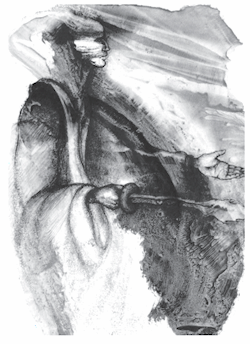 As we journey through our life experiences we might shed belief systems that no longer resonate with us. I see these as layers of the coat being dropped so that one can see more clearly the truth – your load becomes lighter, your life more joyful, as you nudge ever more closely to the truth of who you really are.
Just like the layers of the coat, there are layers of the truth. I’ve termed the layers of truth relating to the coat, the ego, as subjective truth. Subjective truth is on the surface and is always changing depending on what one is thinking, feeling and believing at the time. Subjective in the dictionary means, adj. belonging to the thinking subject rather than to the object of thought. So subjective truth is based on what you perceive, think, feel and believe about a situation, so naturally it changes as we change. I hear a lot about personal truth; this I believe falls into this realm of subjective truth.
We have seen throughout history and in our day-to-day lives, people arguing and fighting over the truth – one’s personal truth, a culture’s truth; all of this fighting to claim that I am right and you are wrong. Who is it that must be right? Who is it that must have their truth validated and recognised? This mentality keeps one in a state of untruth, of me and them, of separateness. Is it not just the ego self that wants these things? For truth requires no argument.
Absolute truth is what I have termed for the energy that exists underneath the coat of the ego. Absolute truth exists no matter what I think/feel/believe. It is unchanging and remains the same. This absolute truth is the truth of who you are, the I AM presence residing within us all.
So if these words are pointing you in the direction of truth, which way are they pointing? Deep within.
As we journey through life and discover more of who we are, we come to know and understand the layers of the coat that we wear. We may then say that I am clever, I am pretty, I am this and I am that, the truth of it all is simply that I AM.
Renee Cashman
Truth to me does not simply imply telling the truth, but living the truth. I remember a story about a man who searched far and wide for the Goddess of Truth that he may return to the people and share the knowledge. After a long search he found her – an old, ugly, haggard woman and he stayed many years with her. When it was time to leave he asked her, “And what shall I tell the people when they ask of you?”
“Tell them that I am young and beautiful,” she says.
Regular Article

Long ago there lived a king who was decent in every respect ex-
cept one; he loved to have his way with beautiful women. In all
his realm not a single attractive woman, Jew or Gentile, was safe
from his lust. No sooner would he lay his eyes on one, than he
would force her to submit to him.
Not far from the king’s palace lived a Jewish sage who
was married to one of the most beautiful women in the kingdom.
Since he knew very well of the king’s passion for women, he would
bolt the door to his house each morning before setting out for the
house of study.
The king had heard about the sage’s beautiful wife, and
each morning he would look out of the palace window to see wheth-
er the rabbi had bolted his door. Each morning the king was disap-
pointed. One day however, the sage forgot to lock his wife safely
inside their house, and the king seized the opportunity to force him-
self upon her. Without even knocking on the door the king entered
the sage’s home and demanded that the beautiful woman submit
herself to his lustful desires.
“Very well,” she answered, trying to think of a way to stall
for time. “Only wait here for a moment, Sire, so that I may go pre-
pare myself for you. While you are waiting, perhaps you would like
to read this.”
She handed him the Torah. Instead of going to prepare
herself for the king, however, the faithful wife slipped out of the bed-
room window and ran to hide in a neighbour’s house.
Meanwhile the king sat poring over the Torah and soon
became engrossed in its teachings. Losing all sense of time, he
read for an hour, then two, then three. Finally he realised that it was
getting late. Without even bothering to look for the sage’s wife, he
took a bag of gold and left it, along with his rosary, on her bed. Then
because he wanted to continue his reading, he picked up the Book
of Torah and left.
The neighbour in whose home she was hiding informed
the resourceful wife that the king had gone. As the hour for the mid-
day meal was approaching, the wife immediately went to her kitchen
and prepared lunch for her husband and herself. Her husband came
home, ate his meal, and then happened to walk into the bedroom.
There he found the bag of gold and the king’s rosary lying on the
bed.
Assuming the worst, he stared hard at his wife and de-
clared through his teeth. “So the king has fi nally had his way with
you!”
“No, I…” she started to protest. But then she thought to
herself, “No matter what I say, he will never believe me.”
So the poor woman remained silent, imploring him with
her loving eyes to have pity on her. But from that day forward the
sage neither came to his wife nor spoke to her.
Several months went by, and the faithful wife fell ill. No
doctor could be found, and her condition rapidly grew worse, until it
seemed that she would soon die. Word was sent to her three broth-
ers, who lived in a nearby town, and they came immediately. When
they had gathered around their sister’s sickbed, she told them about
the king’s attempt to force himself on her and how she had man-
aged to avoid him by hiding in a neighbour’s house. “But my hus-
band has lost all trust in me,” she muttered in a weak voice. “He will
not touch me and no longer utters a word to me.”
Hearing this, her brothers went to the sage and insisted
that he go with them to see the king. He agreed, and soon all four
of them stood before the monarch. Searching for a way to present
their case without angering the king, one of the brothers decided to
relate to him something of a parable.
“A few years ago,” be began his tale, “our father of
blessed memory, passed away. The inheritance that he left us in-
cluded a house, a vineyard, some fi elds and a garden. The three of
us who have come to see you with this sage are brothers. One of us
took the house, another works the vineyard and the third attends to
the fi elds. But we did not know what to do with the garden, until this
wise man here came along. He offered to cultivate the garden, and
we signed a contract with him on the condition that he indeed tend
to it. For the past several months, however, he has not lived up to
the terms of the contract. The land was left untilled and the ground
uncared for. Because he has neglected our precious garden, we
ask that he return it to us.”
The king listened carefully to all the brother had to say.
Then he turned to the sage and asked, “How do you respond to
these accusations?”
“What these men say is true,” the sage answered. “I have
not taken care of the garden over these recent months. Prior to that
time, however, I tended the garden most faithfully, according to my
duty. But one day, much to my sorrow, I found the footprints of the
king’s lion in the midst of my garden, and I realised that the lion had
made off with the garden’s fruit. Indeed, I am afraid that soon the
lion will return to the garden and take my life.”
Now the king had grown wiser from his reading of the
Torah that he had taken from the sage’s home. Therefore he under-
stood everything alluded to in the parable he was told, and he knew
what had to be done.
“I realise that my lion used to wander about the city to
prey on the innocent,” the king told the sage and the three broth-
ers. “But you should know that he will wander no more. For I have
built up powerful walls to keep him in his den. Know, too, that even
though the lion was prowling in your garden, he did not take a single
fruit from it or touch a single fl ower. For the fence surrounding your
garden was much too high for him to climb. Therefore he left, taking
only a single bunch of grapes, which I shall now return to you.”
At that the king pulled the Torah out from under his robes
and handed it to the sage, who was overjoyed at the king’s words.
With his brothers-in-law trailing behind him, the sage hurried home
to his wife and begged her forgiveness for having falsely accused
her. He offered her words of kindness and loving caress. Soon she
recovered from her illness, and the two of them lived happily togeth-
er in a kingdom ruled by a king who had received the light of Torah.
The Universal Storyteller