

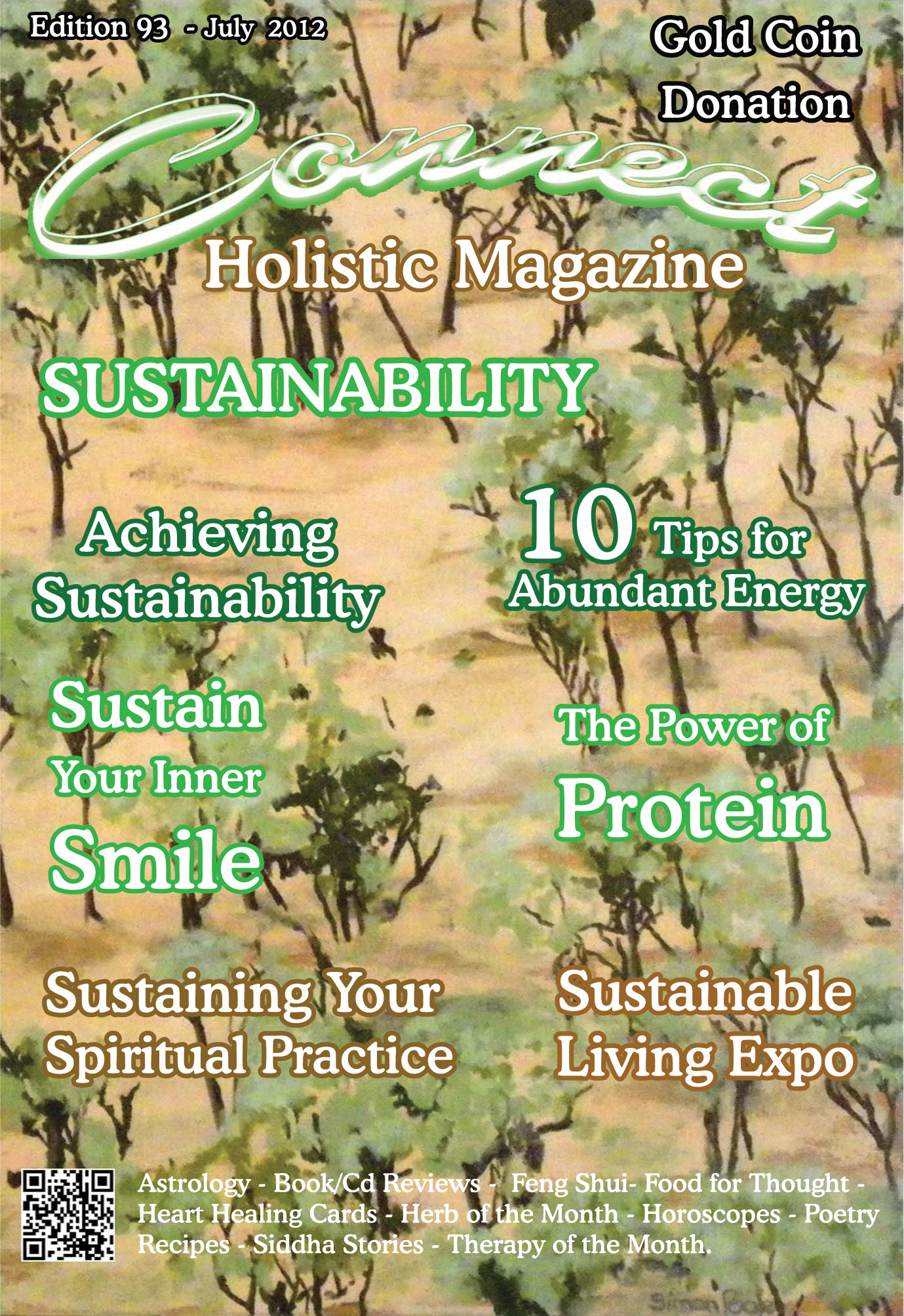
 Artist: Simon Poole
Title: Savannah from Bob’s Lookout – Road to Cooktown
Medium: Acrylic on canvas
Contact: info@simonpoole.com.au
FEATURE ARTICLE
Sustainability: More Than Just Doing Things Less Badly
I heard Bob Katter say on radio recently that for the current advocates of free market economics to understand any other view is like a man born blind trying to comprehend the sun; it seems to lie beyond their capacity to comprehend any alternative. When an entire civilisation develops in the shadow of a pervading mythology about its place in the universe – a mythology that puts man at the end point of creation as Supreme Being, able to ignore the rules of life that have shaped and ordered existence from time immemorial – the result is a civilisation blind to any alternative understanding; a civilisation doomed to crash as sure as a blind man driving a Maserati.
The fundamental challenge for those interested in progressing a sustainable civilisation is not decarbonising the economy or waste minimisation; these are important but are symptoms rather than drivers. No, the key challenge is achieving an awakening about our true place in nature. The challenge is throwing out the existing mythology, which is clearly fatally flawed, and replacing it with one that will deliver sanity to the planet and to human-to-human relations.
Mainstream discussion about sustainability has focused largely on technical ‘solutions’ to our climate, energy and waste issues. If this is where the level of focus remains we are sunk, because fixing symptoms is never a cure. New energy systems and waste minimisation strategies will not stop the ongoing over-consumption of the Earth’s productive capacity by man and his livestock slaves – in fact they may well exacerbate it.
 Sustainability will only be achieved through a new understanding of our relationship to nature and her systems, a relationship that respects and abides by the limits and rules that allow all life to prosper and evolve. So our first action must be to challenge the current mythologies: that man has the right to take whatever he wishes; that unending growth is good; that continued economic growth will allow us to solve our problems; that the free market system delivers optimal allocation of resources; that we can achieve any kind of sustainability within the current macro-economic paradigm; that sustainability is an environmental issue, and that human rights and environmental degradation are separate issues.
Our efforts to develop new energy systems and economies will only work within the context of this new relationship with nature and each other. We have waged a war on the planet: how else could one describe the extermination of any competitors for land and food; the relentless destruction of ecosystems to fuel our economies; the choking of nearly all the world’s significant rivers and sucking them dry of their waters; the dumping of billions of tons of toxins and pollutants into the atmosphere, rivers and oceans?
But we have also declared war on each other, allowing billions to go without, as a small percentage hold the bulk of the world’s wealth; developed nations appropriating the resources of poor nations through scandalous abuse of power and sly manoeuvring, enslaving generations in unpayable debt. The story of sustainability is the story of justice, equity and living within the limits of the Earth’s capacity to provide for all life for all time. It is also the story of connectivity: we have been in an age of disconnection from nature and from each other; we must move to the age of reconnection.
How can we shift from this flawed mythology to our new story? The obstacles are, sadly, large and numerous. Firstly, anyone challenging the ‘growth is good paradigm’ or the free market neoclassical economic system, the engine of our destructive ways (most of our major problems such as climate change, biodiversity loss and poverty are the result of failure of the free market system) tends to be written off as a heretic, such is the blindness around us. John Roulston Sawl described this aptly as, ‘the unconscious civilisation’. But challenge we must – we must tackle the assumptions that like rusty chains keep us wedded to this suicidal train.
The second obstacle is complexity – the sheer complexity of the modern life we have created makes it extremely difficult to shift this system in any direction at all, with huge amounts of effort needed to bring about small incremental changes. The complexity of the system also places undue demands on our energy systems; Joseph Tainter ascribes the fall of civilisations such as ancient Rome to the fact they were unable to meet the energy requirements needed to sustain their complexity. Localisation is a key antidote to the complexity challenge.
Another critical obstacle is the global and national institutions such as the World Trade Organisation, the IMF, the World Bank and the Corporations Act, which make a shift to any other system very difficult, and entrench the current problems rather than drive solutions. They are driving a globalisation agenda that undermines localism, diversity, autonomy and choice. Add to this an increasingly corporatised media that keeps the community focused on short-term issues and a fascination with celebrity, and you have an enormous challenge in driving any systematic change for good.
The Internet and independent media (Connect!) are helping to challenge the mainstream media – to allow other stories to be told, for other perspectives to be considered, for the possibility of a globalisation based on connectivity rather than uniformity.
The other key challenge is that many people do not appreciate that there is any alternative to the current system beyond retreating to caves and eating bark. We have failed to present sustainability as an opportunity to regain meaning, time, connectivity to family, friends, to the Earth that nurtures and sustains our minds, bellies and souls. The truth is that whilst slavery was abolished a long time ago, a new slavery has replaced it where the bulk of humanity is entrapped on a consumption treadmill, too busy to look up, too bombarded by the pervasive world-view to see any other. We are slaves to the economy when the economy should exist to serve us.
We must have a positive story to tell if we are to engage our fellows on this journey to a sane world. But having a positive story is not enough; it is equally important for people to appreciate why we must leave this mythology behind, and the urgency of the challenge before us. Hope can only be achieved through us understanding that we have stepped off the cliff; we have already significantly overshot the Earth’s capacity to sustain us, and we are still expecting another 1,000,000,000 souls to join us in the next 15 years. It is this understanding of the scale and depth of our dilemma and why we find ourselves here at this place, that will fuel any kind of meaningful transition, and the positive story will be our roadmap toward the light.
Can sustainability even be achieved, given where we find ourselves, given the giant holes we have torn and continue to tear in the web of life? Who knows? My hope lies in the non-linearity of systems and the capacity for rapid shifts in state when the right conditions are reached. I think the most critical thing we can do is try to awaken as many people as possible to the deep realties that confront us, and try and remove the blind spot that is preventing society at large from changing course. If we can awaken a critical mass it may be enough to trigger the system change we need. Exactly how we achieve sustainability we will have to work out along the way. The change will not come from above; our politicians are mostly blind to the failings of this mythology and the political system is short-term and incapable of delivering the change we need. The change will come from you and me and the millions of ordinary folk who can see this is a giant train wreck, and tweaking the knobs will not avoid the crash; we must abandon this train for something better.
So consider driving change on three scales: your personal life, your community and in advocating for change and sanity in government. The most critical of these is the community scale, where your sphere of influence is likely to be greatest. Let us awaken the critical mass and begin a new chapter, one where we might proudly and justly wear the mantle of calling ourselves civilised.
John Rainbird
REGULAR FEATURE
Proteins – Essential Amino Acids
Your brain and every bodily system require protein for:
• Enzymes, which help with digestion and every body function
• Hormones, which regulate growth and many bodily systems
• Muscle, skin
• The immune system
Proteins are essential constituents of plant and animal cells. There is no life without proteins. All proteins are built up of smaller units, the AMINO ACIDS. When food is digested, the protein is broken down into amino acids, which are then put together again in various combinations to make the particular kinds of protein that enter into human muscle, red blood cells, and other body tissues.
Our bodies can manufacture some of the 23 amino acids we need to form our own proteins, but there are eight amino acids, called ‘essential’ amino acids, that we cannot manufacture: isoleucine, leucine, lysine, methionine, phenylalanine, threonine, tryptophan and valine. Arginine and histidine are sometimes included in the essential list, making it ten. Alanine, cystine, glycine, proline, serine, tyrosine and other amino acids can be manufactured by the body.
 A given protein food does not necessarily contain all of the essential amino acids. In order to ensure an adequate intake of all the essential amino acids, a variety of proteins is important, e.g. meat, fish, poultry, eggs, tofu, beans, quinoa, nuts and seeds.
If the diet is deficient in proteins containing these essential amino acids, normal physical and mental development cannot take place. Lack of protein causes weakness and loss of resistance to disease.
Two sources of protein for nutrition
Animal Protein
• Game, poultry
• Fish
• Eggs
• Meat: lamb, beef
Vegetable Protein
Protein forms part of all living plant cells. There is, therefore, a proportion of protein in green vegetables although the amount is small. Since root vegetables contain a high proportion of water, their protein content is also low. Among seeds, the proportion of protein is highest in peas and beans – the greatest being in the soya bean. Nuts contain amounts of protein similar to those in peas and beans.
Most plants have incomplete protein – they are usually deficient in at least one essential amino acid. SOYA and QUINOA are the exception to the rule, as these provide all the essential amino acids, and as such are considered complete proteins. Lentils only have six amino acids, so they cannot build a full protein. Rice has only seven; hence this is also not a full protein.
Most vegetarian protein foods contain only portions of the essentials so a varied supply of protein sources is required to bring in the needed amino acids.
Essential Function of the 10 Amino Acids in Body
Arginine
Muscle contracting; cartilage constituent; reproductive organs; controls degeneration of cells.
Histidine
Muscle control; liver formation of glycogen, haemoglobin and semen component.
Isoleucine
All glands (thyroid, pituitary, lymph, adrenals, etc).
Leucine
Counterbalances Isoleucine.
Lysine
Liver and gallbladder. Fat metabolism; regulation of pineal and mammary glands, corpus leuteum, testes and ovaries. Prevention of cell degeneration.
Methionine
Constituent of haemoglobin, tissues and serum. Function of spleen, pancreas and lymph.
Phenylalanine
Involved in eliminating waste; kidney and bladder function.
Threonine
Exchange of amino acids to establish balance.
Tryptophane
Generation of cells and tissues, gastric and pancreatic juices. Optic system
Valine
Function of corpus luteum, mammary glands and ovaries.
Large amounts of protein are not needed but it is absolutely ESSENTIAL to have REGULAR amounts of protein daily.
Faye Rosie, Naturopath, Medical Intuitive, Shaman, Author of The Power of Your Spirit and The Heart Healing Symbol Cards. faye@hearthealing.com.au, 4055 2868