

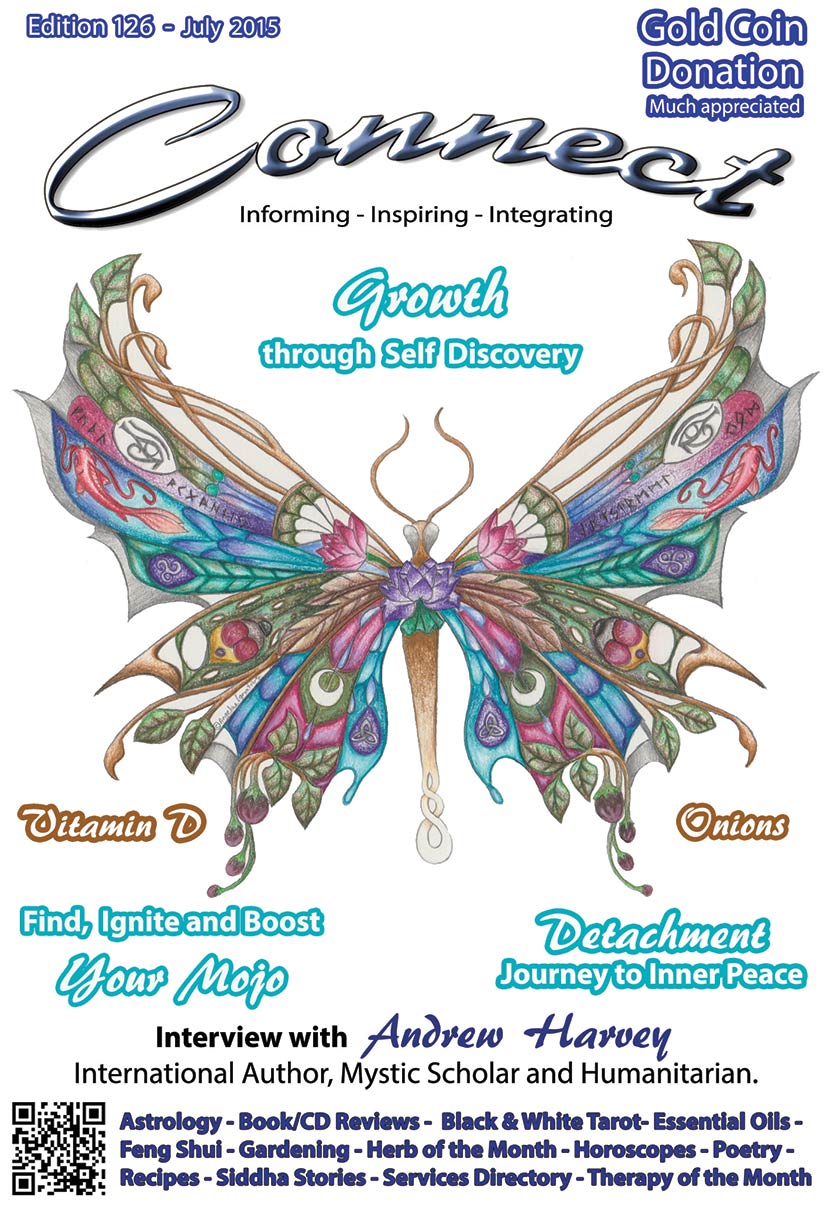
 COVER ARTIST: Angeline Ignatius of Lightning Bug Creative Studios
COVER TITLE: Soul Bound
MEDIUM: Water Colour Pencil
CONTACT: lightningbugcreative@gmail.com
Angeline is a hybrid artist, making art in both (and across) digital and traditional mediums, and co owner of Lightning Bug Creative Studio in partnership with fellow artist and partner Scott Marnock. She enjoys drawing (graphite and watercolour) and painting in digital and traditional mediums. Angeline aims to inspire the spirit by infusing nature and folk lore to create unique art pieces that tell a story to the soul, bringing new dimensions to spiritual and fantasy art with an original and imaginative style, aspiring to stir the imagination and bring light to the hidden beauty of nature and other spiritual cultures.
These words ‘came to me’ many years ago when I was writing to someone who was devastated by being made redundant at the age of sixty. They have since been helpful to me also, when I have faced my own life challenges.
Growth is an essential part of life. Every living thing must grow; there is no standing still. Every difficult situation is an invitation to grow, and if we miss the invitation, it will come again and again, generally each time in a stronger form until we can no longer ignore it. The trouble with waiting until we can’t ignore them any longer, is that these ‘invitations’ can be increasingly unpleasant; for a long time we can tell ourselves, ‘better the devil I know than the devil I don’t’, but if change is needed we must eventually move on in some way, or literally, die.
What does growth mean?
Growth means aiming towards the highest level of self, of ‘beingness’ that we can achieve. The reason that this is not self-explanatory is that we are often heavily focused on the physical aspects of life – work, finances, health, interactions with other people etc, while real growth is about our spiritual advancement. Life and our physical experiences are the means by which growth occurs, but are not meaningful in their own right; when we die the things of the earth won’t exist for us any longer, but we will retain the spiritual advancements we have made through our interactions with physical life.
How does growth occur?
Everything is energy: so we are energy, and energy is always in motion. When people talk about someone or something having good vibes, bad vibes etc, they are consciously or unconsciously recognising levels of energy vibration. Our own energy vibrations change with our emotional state and our degree of inner stillness. Expressions such as ‘feeling light-hearted’ or ‘being overburdened’ recognise that some emotions feel light, and some heavy.
Feeling bad creates a low vibration: some ‘low vibration’ emotions are sadness, anger, jealousy, resentment, guilt, anxiety, fear and other variations of these. Feeling good creates a high vibration: some high vibration emotions are happiness, joy, excitement, enthusiasm, contentment, serenity, and above all, love.
So our growth over a lifetime refers to raising our vibrational level so that we are more and more consistently operating at a higher level. My experience is that this doesn’t happen overnight, but perhaps I’ve been a slow learner. However, here are some things that have helped me (and are still helping me) to slowly tip the balance from lower to higher vibrations.
- Self-awareness: Be willing to honestly review your interactions with other people and the world. It can be tempting to find ways to blame someone else when things go wrong, but the only person we can change is ourselves, so we might as well be open to doing this as necessary.
- Acceptance: Learn to accept whatever has occurred rather than hold on to anger, sadness or other negative emotions by wishing things to be as they were. This doesn’t mean that positive change can’t occur, but acceptance needs to come first: ‘OK, this is how things are. I accept this’– and then, from this place of presence, move on.
- Allow yourself to grieve: Grieving is a vital part of moving forwards after experiencing a loss, so this will be necessary to a greater or lesser degree before acceptance can be reached. There are helpful books on grieving such as On Death and Dying by Elizabeth Kubler-Ross, or seek assistance from a psychologist or counsellor.
- Inner stillness: Find a practice (or more than one) that helps you to achieve inner stillness, and use it regularly so that you can quickly achieve stillness when needed. Some such approaches are meditation, yoga, Reiki and other spiritual practices. Many people also find being in nature, even just a walk in a garden or park, to be very helpful.
- Releasing negative feelings: We often try to ignore or push down feelings like anxiety or sadness, or get rid of feelings like anger by over-reacting. It can sometimes be helpful to talk about our feelings, but I have discovered that my negative feelings are often mostly to do with me (e.g. my desire for a perfectly tidy house, or someone to read my mind and know what I want even when I haven’t told them). So it can be helpful to simply release such feelings, rather than burden others. Go to releasetechnique,com for helpful releasing information.
- Resolve problems from a higher vibration: Albert Einstein wrote, ‘No problem can be solved from the same level of consciousness that created it.’ So the first steps when we have a problem are to accept what is, take time to achieve inner stillness, in this state of stillness seek insights into how to address the problem, and then do so from this higher vibration.
- Play and laugh: It is vitally important to play and laugh as much as possible, to achieve and retain a higher vibration.
When we grow through discovering more of ourselves, we also create a positive vibrational climate in which other people can also grow. So it’s a win-win situation all around.
Annabel Muis. Annabel is a Reiki practitioner and teacher, and co-author of Turning Points, Regaining joy after loss. Ph. 07 4093 8937; E. annabel.muis@internode.on .net
In Maimana lived Abdulwahab, the son of a villager and a man who decided that he should follow the precept of the Wise, where they have said: “Service is superior to advice – but action is better than anything.”
Andulwahab heard the villagers saying that they would not be able to continue paying the heavy taxes demanded by their Khan; that the great dam upon the hill, which supplied water for their valley, would one day collapse, and they badly needed a new mosque.
He also noticed that the local wise man, whose name was Pishki, used to say, every time he heard any of these complaints: “If only one of you would follow my advice, all those problems would be removed from you.”
Abdulwahab’s decision was that he would take the advice, and that he would carry out whatever actions were recommended by the sage.
So he went to Pishki and said: “May I be your sacrifice! I am a member of this community, and I await your commands if you wish to give any orders which will enable the whole village to be saved.”
Pishki said: “You have not much time, so be prepared to start at once. This is what you must do: You will climb the highest mountain and bring down the feather of the greatest eagle. This you must take to the Humai bird, who will give you a spear. You must cut yourself with the spear and give some of the blood to someone as a charm. Then you must take ordinary bread and model it in the form of a man, and have someone eat it. After that you must journey to a place called The Holy. There you will say things that people do not like. Never mind what they are: whatever the people believe, tell them the opposite.
When you have done all these things, return to the village, and you will find that your actions have affected matters in such a manner that all is well and the problems which overshadow us have been removed.”
Abdulwahab did everything just as it was detailed to him, although it took three years. He had one adventure after another, and even attracted numerous disciples, since his repute as the ‘enigmatic Sage’ and the ‘man with a sense of purpose’ had such an effect upon so many people whom he met.
Then he returned to the village.
He said to the first villager whom he met: “I have just come from far away, and have brought down from the highest mountain the feather of the greatest eagle. This I gave to the Humai bird in exchange for a spear.”
The villager said: “Madman! We have no time for such as you – we are preparing a celebration – for the villainous Khan is dead!”
“That was my doing!” shouted Abdulwahab.
“Out of my way, liar…..” said the villager.
Then Abdulwahab saw the local holy man.
“Mulla” he said, “I have to report that we may expect through my exertions that the dam on the hillside will not now collapse!”
The Mulla looked at him sadly, and said: “My son, you have been absent a long time, and it seems as if your wits are absent still. While you were away the streams filling the dam dried up. We found that the old wells near the village were full of water instead so we do not care whether the dam collapses or not.”
“That was my doing!” shouted Abdulwahab.
“Yes, yes” said the Mulla, humouring him.
Then Abdulwahab saw the Imam of the local mosque. “Imam!” he shouted, “you need not now wait for a new mosque for you will have one almost at once, since I have arranged it through my exertions!”
The Imam said: “We do not need a second new mosque.”
Abdulwahab exclaimed: “You haven’t got a first new mosque yet!”
“But we have” said the Imam: “while you were away there was a rich man who came and handed us many bags of gold for a new mosque. It was on the day that I found a piece of bread modelled into the form of a man. I told the rich man and he said: “If there are so many idolators around, you should have a new mosque.’”
“It was my doing!” said Abdulwahab.
But nobody would believe him.
Abdulwahab went to see the Sage Pishki about the matter, but when he reached the old man’s house he found that he had died.
The Universal Storyteller