

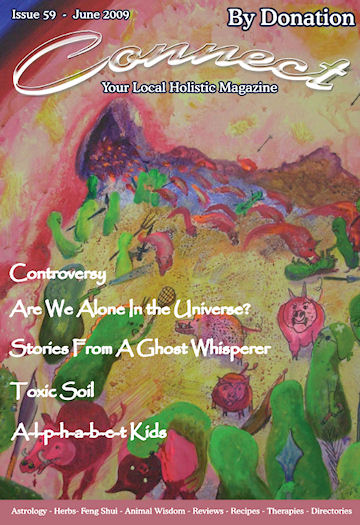
 Cover Title: Swine Flu
Medium: Acrylic Paint
Artist: Susan Ascott-Evans
Contact: sueperb1@yahoo.com
Feature Article: Controversy – An Unacknowledged Asset?

We are all continually confronted by controversies, differing opinions, paradigms, and ideas in areas such as religion, politics, family matters and health systems, food choices, to name only a few. Serious fights, even physical, can erupt due to differing opinions between individuals and groups as they look for consensus and solutions. Political controversies and opposites even create wars – and have done so since the dawn of humanity.
In daily life controversial ideas create discussions (sometimes heated!) with the aim of reaching some sort of workable compromise and finding middle ground. It is part of healthy interaction between parties of opposing beliefs and a means of putting one’s point of view across to resolve issues.
In my profession and the health profession at large, controversies abound. People are either ‘for it’ or ‘against it’, i.e. natural integrative medicine versus allopathic ‘conventional’ drug orientated medicine. People ‘believe’ in a certain system and reject the others. In my opinion there is nothing worse than rigid belief systems that do not allow people to venture outside their fixed paradigms to investigate and explore the other side. This mental/intellectual rigidity is often born from fear of the unknown and prevents a person from considering other ideas and broadening their mind and knowledge base. They feel threatened and insecure when leaving their mental/intellectual comfort zone.
Religious sects consider it heresy to wander off and explore someone else’s belief system. Yes, there are still people who believe that the earth is flat…
A few months ago I met a nice young man who belongs to a rigid fundamentalist Bible group, who said that they were told that the Earth is 6000 years old and that all other beliefs were of the devil… I mentioned archaeological evidence of civilisations reaching back 40-60,000 years. His answer: “This is put there by the devil to test our belief in God.” He was absolutely serious and totally believes the brainwashing. His whole social life is being managed by the group, and he has alienated himself from his family who are broadminded, intelligent and well-read people.
This is only one example of how gullible some people are. They block themselves off from any discussion about an alternative – even scientifically validated – viewpoint, or from entering into any controversy in order to explore and learn.
Controversies can be positive if we accept them as learning experiences. Exploring differing viewpoints and researching the origin of another person or group’s opinion can broaden our worldview without being judgmental.
by Veronica Griffin.
Regular Article: St John’s Wort – The Blues Buster
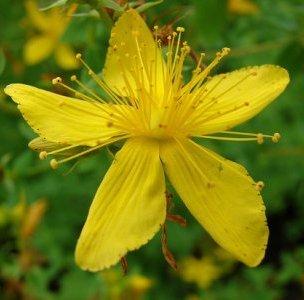
Hypericum perforatum
 Character and Parts Used:
Hypericum perforatum is a yellow-flowering perennial herb indigenous to Europe that has been introduced to many other temperate areas of the world. The leaves and flowers of St John’s Wort contain special glands that release red oil when pinched. Early Christians named the plant in honour of John the Baptist because they believed it released its blood-red oil on the traditional flowering and harvest day – St John’s day, 24th June. The genus name Hypericum is derived from the Greek words yper=upper and eikon=picture, which refers to the traditional use of the plant to ward off evil, by hanging plants over a religious icon in the house during St John’s day. The species name perforatum refers to the presence of small oil glands in the leaves that look like windows, which can be seen when they are held against the light. St John’s Wort is a cooling, bittersweet masculine herb, ruled by the sun, element of fire, and is used for health, protection, strength, love, divination and happiness.
Research and Through the Ages:
The ancient herbalists knew about the powers of St John’s Wort, notably for its ability to speed wound healing. And more recently scientists have gathered some evidence on the herb’s possible effectiveness as an immune system stimulant. In the first century Pliny prescribed it to be drunk in wine for snakebites, and the Greek physician, Dioscorides, recommended it externally for burns and internally as a diuretic, as a female tonic, and for sciatica and malaria. Christians adopted the pagan belief that St John’s Wort repelled evil spirits and burned it in bonfires on St John’s Eve to purify the air, drive away evil spirits and ensure healthy crops. In more recent times it has become known for its use with mild to moderate depression.
St John’s Wort doth charm all witches away,
If gathered at midnight on the saints’ holy day.
Any devils and witches have no power to charm,
Those that gather the plant for a charm.
Rub the lintels with that red juicy ? ower,
No thunder nor tempest will then have the power.
To hurt or hinder your house and bind
Round your neck a charm of a similar kind.
Poem from 1400’s
Uses:
Traditionally used as a sedative and pain-reducing herb it provides treatment for neuralgia, anxiety and tension, and is useful for sciatica and rheumatic pain. It is used for menopausal changes that trigger irritability. It has long been recommended for depression however it is considered slow acting and requires many months’ use for its effect to be felt. Hypericin appears to interfere with the activity of a chemical in the body known as monoamine oxidase (MAO). MAO inhibitors are an important class of anti-depressant drugs. In a German study successful treatment for depression resulted after taking St John’s Wort including increased appetite, greater interest in life, improved feelings of self worth and more normal sleep patterns. Externally it is a valuable healing and anti-inflammatory remedy. It can be used in lotions speeding the healing of wounds and bruises, varicose veins and mild burns. The oil is useful for sunburn. It contains glycosides including rutin, volatile oils, tannin, resin and pectins, and is used as an anti-inflammatory, astringent, vulnerary, sedative and analgesic.
Tea Infusion: Pour a cup of boiling water onto 1-2 teaspoons of the dried herb (the shoots, leaves and flowers) and leave to infuse for 10 minutes. Sip one cup three times a day.
Tincture: Take 1-4ml three times a day.
Oil Infusion: Use on burns and muscle or joint inflammation including tennis elbow, neuralgia and sciatica. Add a few drops of lavender oil for burns and yarrow oil for joint inflammations. (Add 2 teaspoons of dried herb to oil and infuse for at least one month before using. Store in a cool dark place. Strain away herb and add to an ointment or cream base for use).
Cautions and Warnings:
Whilst using St John’s Wort do not take selective amphetamines, narcotics, the amino acids tryptophan and tyrosine, diet pills, asthma inhalants, cold or hay fever medications or nasal decongestants (due to the MAO inhibitors). Contraindicated with SSRI’s –selective serotonin re-uptake inhibitors, cyclosporine, various anti-virals for HIV patients, digoxin, warfarin and oral contraceptives. If St John’s Wort causes headache, stiff neck or nausea stop using it immediately and if symptoms persist consult your physician. If suffering severe depression consult your health physician. If you have any concerns about this herb consult your naturopath or herbalist.
Email: kazgreen@dodo.com.au or call me Karen Green 0400 836 254