

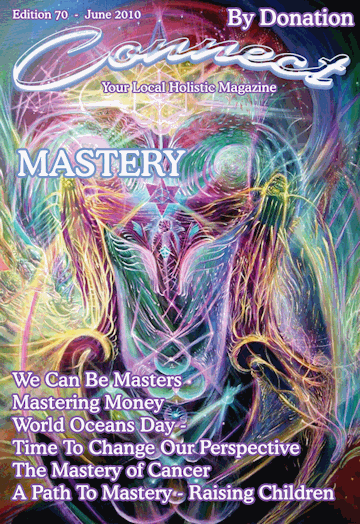
 Cover Artist: Kuba Fiedorowicz
Title: The Chohan
Contact: www.vineofadam.com / www.plemora.com
Feature Article

When we hear the word ‘mastery’ we have a sense of what it
means. Our understanding will perhaps include elements of
expert knowledge, outstanding ability or maybe of authority over
others. I think of this concept in terms of our ability to be all that we
are capable of being – all that we are, and are not yet expressing.
People can exhibit mastery in many fields: in creative or
artistic expression, physical skill, as a communicator, a therapist, a
parent; virtually any area we might think of. Many people are very
good at what they do. But what makes the difference between very
good, and mastery?
As I was thinking about this I recalled the progress of
my first child through the early developmental stages, as he learnt
to sit up, crawl and walk. When he was a few months old he was
lightly harnessed into a bassinette in the back seat of the car. The
car had broken down and I was waiting for roadside assistance,
when I noticed that my baby had pulled himself up into a half-sit-
ting position in the bassinette. It was the first time he had done this,
and he was beaming. Over the next couple of weeks he practised
this new skill with expressions of delight, and then I noticed that
whenever he pulled himself up, rather than displaying pleasure he
was fretting. This continued a while longer, until one day he rolled
onto his tummy and lifted his head and chest. Again, smiles of de-
light with this action at first, and then frustration. The pattern was
repeated with each new skill learnt – he found that he could get
up onto hands and knees and loved it for a while, then he rocked
and fretted until he discovered how to shift his hands and legs and
move forwards. After the initial excitement of crawling he fretted
again until he was able to stand and to walk.
What drives us to progress? If a baby’s physical needs
for food, warmth and comfort are being well met, why would they
even attempt to develop new abilities? Thinking of my son, it ap-
pears that humans have an innate drive to become more than they
are expressing right now. Just as a seed holds the knowledge of
the tree that hides within it, within each of us is awareness of the
perfection – the divine essence – within, and a drive to manifest
this. This is the ultimate mastery.
Psychologist Abraham Maslow developed a theory of
motivation known as Maslow’s Hierarchy of Needs. His theory was
that humans are driven by instinctual needs, beginning with the
basic physiological needs that are essential to physical survival.
As each need is well enough met, we begin to experience restless-
ness and feel driven to satisfy the next level of need. In progres-
sive order, the needs identified by Maslow are: basic physiological
needs (for water, food, shelter etc); safety and security; belonging/
love; recognition/esteem; and self-actualisation. Self-actualisation
refers to our innate need to be all that we are capable of being: to
become what we were ‘born to be’; to be masters.
What were you born to be? Like the seed that becomes
the tree, each of us knows this intuitively. However, our intuitive
knowing can become buried under layers of childhood conditioning
and false beliefs, programming to follow the expectations of
parent figures, teachers and society to become what we ‘should’
be, rather than what our inner wisdom guides us to pursue.
Someone I knew as a child loved working with timber. As
a youth he carved beautiful pieces from wood. He wanted to make
furniture, but his family considered this to be an inferior occupation
and pressed him to study dentistry. He is a good dentist but will
never be a master because his heart isn’t in it. Had he followed
his inner guidance, perhaps he would now be a master furniture
maker.
Within every one of us is a master waiting for expres-
sion. How can we release and develop this potential? Once again,
Abraham Maslow had some advice. He believed that the education
system needed to provide certain ‘growth-promoting approaches’.
However, as adults we’re beyond the education system’s influ-
ence, and probably didn’t experience these approaches, so we
must find ways to develop our potential for ourselves. Primary
among Maslow’s growth-promoting approaches are:
• We need to transcend our social and cultural conditioning and
develop our own beliefs and values;
• We need to learn to recognise our inner voice and to become
authentic in our self-talk and our outward expression with others;
• We need to listen to our inner voice to discover our vocation
in life.
There are many personal growth and spiritual practices that can
assist us to achieve these goals. This is not an overnight process;
it takes time and persistence to change a lifetime of programming,
and then we need the courage to act on our awareness of our own
particular life path.
Finally, two other quotations reflect important keys to mastery:
We can hope to gain ‘…no skill without study, or mastery
without apprenticeship.’
Ralph Waldo Emerson
And:
‘Desire is the key to motivation, but it’s the determination and
commitment to an unrelenting pursuit of your goal –
a commitment to excellence – that will enable you to attain
the success you seek.’
Mario Andretti
We can indeed be masters, through discovery of and progression
towards our own unique expression of the divine.
Annabel Muis
Regular Article
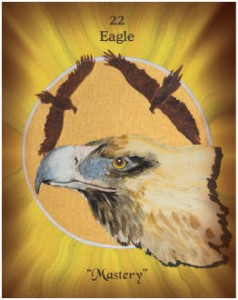
Eagle is considered the most sacred of all birds of fl ight and Aus-
tralia has been graced with more than one species. The most
common is Wedge-Tailed Eagle. This master of the air soars high
above all that exists upon the earth below him.
Wedge-Tailed Eagle has a distinguishable tail shape,
which is easily recognised from a great distance. He mates for life
but seldom reveals the location of their nesting site. Their territory
covers many square kilometres and you can be sure that the nest
is hidden in the most inhospitable place. One or more eggs are laid
and when hatched, the strongest fl edgling will make a meal out of
its siblings until only one survives.
 The adults stay with the adolescent until the next breed-
ing cycle starts and then the family of three will become two as the
young Eagle is chased out of the adults’ territory to fi nd its own. If
you spot Eagle fl ying solo, it is usually an adolescent. He will be light
brown in colour, and as he reaches maturity his colour changes to
black.
Eagle was born to soar and will only come to ground to
kill, drink or feed from a carcass. The King and Queen of the heav-
ens are never too proud to dine on a rotting corpse that others have
left behind. Eagle is equally grateful for any meal that nature offers.
Other birds fear Eagle’s presence. He is fi ercely attacked
by his feathered cousins who try to drive him out of their nesting
areas. Eagle would gladly make a meal out of other birds’ young,
and when under attack the other birds screech and squawk, flap-
ping their wings in earnest. But Eagle simply spirals upward to the
heavens where he glides effortlessly and is soon at great altitude.
Anything that wishes to bring him down is simply left breathless and
exhausted far below.
The ancients tell us that Eagle is the connection between
heaven and earth. He carries our prayers to the ears of the Great
Spirit. As Eagle spirals upward, his mighty wings brush the face of
the Creator himself.
Wedge-Tailed Eagle is fearless. He has mastered the
lofty heights well and pilots often tell stories of Eagle riding fierce
turbulent storm heads at heights not visible to men that walk upon
mother Earth.
The feathers of Eagle are prized by Shaman Healers as
being the most sacred of all healing tools. If Eagle has come to your
hand today he asks you to draw upon his medicine. “I offer you
direction to master your earth walk,” he says.
Eagle reminds you that he does not allow others with ill-
intent to enter his sacred space. If you are currently experiencing
such diffi culties Eagle says, “Rise above the situation or energy and
go within as I do. Enter your sacred space and do not allow negativ-
ity to affect you. Pettiness only serves to lead you away from your
path. If I have come to your hand I ask you to rise to lofty heights
above all negativity that would wish to engage you.”
Perhaps you are currently experiencing trying times that
have disrupted the fl ow. Do not waste your life-force on wallowing
right now; these tests are before you to show you ways to master
your life lessons. “Follow my example,” repeats Eagle. “Rise above
all and be a silent witness to the diffi culties of mankind. When you
reach the highest plane of awareness with keen intuitive sight you
will soon enough see a peaceful resolution to your present predica-
ment. Watch how I handle the attacks of others, I simply rise above
and stay calm in the silence.”
Eagle tells you that even though the Creator has given
him a clear run of the heavens he still comes to earth humbly to
sustain himself. He reminds you to ground yourself and call upon
the energy of Mother Earth also. People who utilise Eagle medi-
cine reach positions of regard within communities; they are able to
lead by example and are equally comfortable in the inner and outer
worlds (the heavens and the earth) with the same regal resolve and
peace in both.
Eagle also asks you to consider whether it is time to
‘chase your offspring’ out of the shadow of your wingspan. Eagle
reminds you that your offspring, protégés and those you teach or
lead are created in the essence of your wisdom. Allowing them to
stay in the shadow of your wings will not serve them or you.
Eagle asks, “Is it time for you to enter the next cycle of
your life?” He reminds you that you need to focus your energy now
to create your next experience. Let go and master your own growth
so that others may master theirs also.
The medicine of Eagle tells you that you have played your
role well. Everyone will be masters of their own wings if given a
reason and the motivation to fl y. Eagle states, “I am the messenger.
Call upon me and I will see that your needs are taken to the ever
open ears of the Creator.”
© Trevor O’Sullivan & 2009 Co-Author Susan Skyring
To Purchase the Australian Wildlife Wisdom Cards. Visit
www.wildlifewisdom.com or Susan www.metaphysicallyspeaking.com