


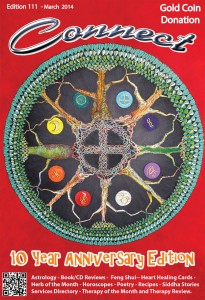
 ARTIST: Clive Walters
TITLE: Roots
MEDIUM: Acrylic and ink on paper
Contact: cliveoutside@gmail.com
Facebook: Mandala Magick Visionary Art Gallery
FEATURE ARTICLE
Building Community
‘In and through community lies the salvation of the world.’ Scott Peck
Many of us desire to contribute to resolving global problems of conflict, starvation, environmental degradation and the subordination of certain groups. We tend to look for large-scale solutions, while in fact the ‘training ground’ for us to begin addressing such concerns is our own communities.
 We are each part of a number of communities such as family, the town where we live, work, sporting or religious groups. However, few of us have experienced real community. Community is a special way in which a community can function: through mutual understanding, acceptance and cooperation, ‘community’ provides fully for the physical, mental/emotional and spiritual needs of an overall community and all of its members.
Some years ago I was part of a group driving across Australia in a campervan (we became a temporary community). Before we left Cairns some issues had already arisen, and within the first 24 hours considerably different needs became evident, related to communication, leadership, decision-making, finance, safety, diet and sleep. Since leaving members of the group on the roadside was not an option, we had to resolve these issues sufficiently to live together amicably for the duration of the trip. We were able to do this, and by the time we arrived back home a level of liking and bonding had developed between us all. However, because our time together was limited we hadn’t needed to address issues at a deep level.
Similarly, in most of our communities we address the issues that we can’t avoid, we try to ‘make the best of’ other differences, or we leave one community and look for another with which we think we will be more compatible.
Communicating effectively
To build community we must discover how to communicate and relate honestly and respectfully, to accept and incorporate differences. We must be willing to deal with problems, not opt out when the going gets tough. Building community is real, difficult, and sometimes scary. But only by doing so will we establish the kind of mutual support and cooperation that will help us tackle the deepest issues within ourselves, within our communities and ultimately within the world.
Good communication is the most important foundation for building community. This means listening and speaking in a way that leads people to an accurate two-way understanding of each others’ ideas, needs and values. Most of us learned how to communicate as little children, by watching, listening and copying the way the adults in our lives – often not very effective communicators – communicated. So it is fortunate that communication skills can be re-learned.
People in any group will always have different needs and values. Differences can be managed if we want to do so, are willing to communicate openly, and take the trouble to understand each other. However, people often feel that they will be vulnerable if they expose too much information about themselves. It is also common for people to be more intent on getting their own point of view across than on listening.
Practising the following can help to build better understanding:
• Listen more than you speak
• Recognise that your ideas, needs and feelings are based only on your experience; others’ ideas, needs and feelings are equally valid, given their different experience
• Avoid being dogmatic, judging, labelling and blaming, which lead to communication breakdown
• Really listen, and then check that you have understood before you respond; others are then likely to be more willing to listen to you in turn
• ‘I messages’ (‘I feel…’, ‘The way I see it is…’) are helpful ways to communicate your feelings, views and needs without getting others’ backs up
• Acknowledging someone’s positive contributions is helpful; focusing only on their mistakes or deficits is not
Eliminating separateness
Western cultures focus heavily on individuality and competitiveness. Children subliminally absorb messages like, ‘there’s not enough for everyone’, ‘I have to look out for myself’, ‘there can only be one winner’. If we are to have any hope of achieving community we must be willing to recognise and then change our own deep-seated, divisive attitudes. I can dislike a person’s behaviour and still understand that this is a human being who, like me is just trying to make life work, each of us using programming we learned when we were young.
In his book The Hundredth Monkey Ken Keyes Jr. addresses this particularly well.
‘Our mental habits of understanding events in an ‘us-versus-them’ rather than an ‘us-and-them’ insight are creating a devastating mental, emotional and moral separateness in our minds.
In the millions of years in which our ancestors were surviving in the jungles, it was important for their minds to create an instant ‘self-versus-other’ perception. For animals eat other animals and no species can survive if all of its members are eaten up. This instant perception of ‘otherness’ is basic to survival in the jungle.
We are still creating a ‘jungle’ of our civilised lives by continuing the operation of our ‘us-versus-them’ mental habits.
I may forget that you are not your thoughts and actions. I may forget that in every important way you are like me: you have a human heart that feels pain and warmth, sadness and happiness. In your essence and in your intentions you are basically good – just like me! We are not separate. What we say and do can affect the wellbeing of us all.
If our species is to survive it must replace the illusion of separateness with the emotional experience of acceptance, cooperation and togetherness. However much our ideas and ideologies may clash, we must remember that nothing is more important for survival and for happiness in life than feelings of understanding and commonness of human purpose.
… Human love – our heart-to-heart love – is more valuable than anything else. If we have this, we have enough. Without love in our hearts, nothing else will be enough!
Annabel Muis
REGULAR FEATURES
Heart Healing Cards – Ambience
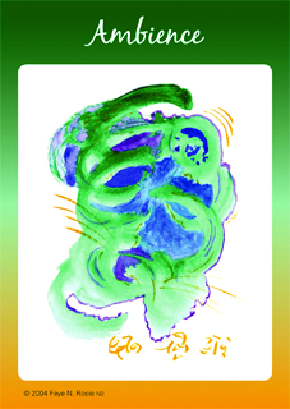 The home, office, workplace or any area that has become heavy in energy can be dissipated and transformed with positive and empowering energy. Each situation is different and each home may require a different atmosphere. One family home may be well suited as an open house for welcoming and embracing friends, family, and the ‘homeless’. Another home may be better suited for fun, laughter, and joy. Another, for serenity and peace. Different rooms could benefit with different energies: calmness, relaxation, nurturing, rejuvenation, releasing, cleansing and restoration.
It is most beneficial when moving into another home to clear out the previous owner’s energy and fill the home with the atmosphere that is most conducive for us and our loved ones. Negative entities may be present, creating general unrest, disturbance, loss of energy, poor sleep, nightmares and psychic interference.
The workplace may benefit by changing the atmosphere to create perhaps harmony and teamwork, welcoming, a place of refuge, safety and nurture.
Ambience’s vibration is for aligning the resonance of the surroundings that we require to be harmonised. Just as water may meet several needs such as to cleanse, hydrate, transport, cool, relax, energise, lubricate or act as a solvent, so Ambience’s vibration ‘adapts’ to meet the special needs for our personal environment.
The Heart Healing Symbols and shamanic healing cards are designed and produced by Faye Rosie.
Faye Rosie, Naturopath, Shaman, Medical Intuitive and author of The Power of your Spirit. Available for personal consultation and workshops. Phone at 4055 2868, by email at faye@hearthealing.com.au, or www.hearthealing.com.au