


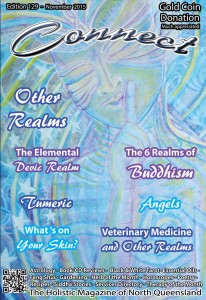
 COVER ARTIST: Jilli Manning
TITLE: Guardian of the New Sun
MEDIUM: Mixed Media
CONTACT: www.bighoneybee.com
Guardians of the new sun (2015) arose in my mind back in 2011, at a plant symposium called EGA- entheogenesis australis. It is underpainted with a visual representation of the islands of genetic junk in our dna where our genomes hang out and illustrates a being invoking peace and safety for the birthing voyage of this new ancient sun. Jilli Manning is a slightly disturbed yet hilarious creature who lives in Cairns. She likes making things and hates speaking in the third person.

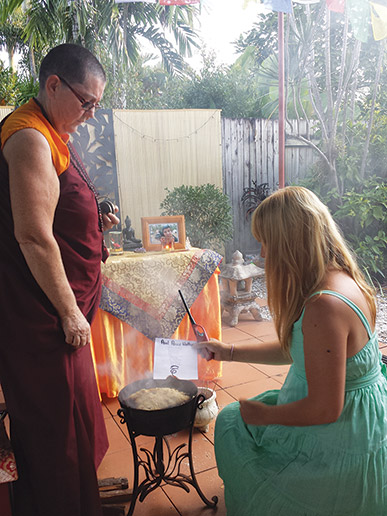
The small group of friends gathered around the ceremonial fire for another farewell to the boy’s spirit. It had been forty-nine days since his sudden passing and in Tibetan Buddhism it was a potent time to offer love, prayers and smoke for the benefit of his journey as well as for those left behind.
The resident nun, Venerable Rinchen, of the Buddhist temple where they gathered, explained to them that a spirit’s journey does not end when it leaves the body, that there are many realms that we can be propelled to due to karmic forces and this ceremony was to assist him in the bardo – the world between worlds, between incarnations. he small group of friends gathered around the ceremonial fire for another farewell to the boy’s spirit. It had been forty-nine days since his sudden passing and in Tibetan Buddhism it was a potent time to offer love, prayers and smoke for the benefit of his journey as well as for those left behind.
The Tibetan Buddhist tradition has concentrated attention on helping the dying person cross the borders of death more than any other religious tradition. The Tibetan Book of the Dead and other sources give detailed descriptions of the stages of death and afterlife.
Rinchen explained that spirits in the bardo are very sensitive to our thoughts and feelings towards them. Through certain rituals, our prayers for their peace and happiness and by consciously sending our love, we can help the spirit orient towards not staying attached to the life they have left behind. Also, through dedicating, we can help them have a better rebirth and also counter some of the sorrow of those left behind.
Rituals are a way of helping the living deal with the loss of a loved one and this particular ritual helps both the living and the deceased.
The group of friends closed their eyes as Rinchen began to chant; a feeling of peacefulness came over them. The sacred mantras familiar to them all, including the boy, were like a nurturing, snuggly blanket being pulled over them.
A mixture had been prepared of flour, butter, honey and sugar which was to be offered to all enlightened beings and to the boy’s spirit. Rinchen explained that spirits in the bardo, although they no longer have a body, can still smell and these ingredients, when blessed and offered to the deceased, are like offering a meal to the loved one. It gives comfort and those in the bardo know we are still caring for and helping them.
As Rinchen offered prayers to the enlightened ones, the boy’s mother added a spoonful of mixture to the fire for each one. It was then time for each of them to offer a spoonful to the fire to feed the boy’s spirit. One by one they offered their love, tears, prayers and blessings to the boy on the other side.
 Rinchen explained the significance of the 49th day. It is said that a person’s consciousness can spend up to forty-nine days in the bardo before being propelled back into one of the other realms of existence. There are six realms of existence and earth is one of the six realms.
The boys’ mother asked the resident nun if the individual does not reincarnate in the earth realm, will the consciousness go to one of the other five worlds of rebirth?
The nun explainded that until our mind is fully enlightened, Awake, we are constantly reborn in these different realms due to our karma (actions). These are the heaven worlds, the hell worlds, the world of hungry ghosts, the asura (demigod) worlds, and the animal worlds. Our rebirth in these realms or worlds is dependent on our karma and our lifespan there is also dependent on this, all these realms are impermanent and we stay there till we have exhausted the karma good or bad that propelled us there. All these realms are unsatisfactory as they are not places where we can create more positive karma either because of too much suffering or too much pleasure. Human realm is considered the best place to reincarnate as it has all the conditions for one to achieve enlightenment or liberation from all the causes of suffering..
This ability to choose a good incarnation requires a mind that has been stabilised by meditation and realisation and has a high degree of conscious awareness. The new age approach to reincarnation which claims we choose our new incarnation is idealistic and not true from this vantage point. The being in the bardo, desperate to escape the confusion of the second bardo, will grab on to the first opportunity that presents itself; like a swimmer who grasps a log in dangerous rapids; in hopes of making it to calmer waters. Choosing the first object (or incarnation) that comes along may not be the wisest choice.
The force of our karma propels us to our next rebirth and we have little control over it, unless we take steps now, while we have this precious human rebirth to cultivate our awareness through meditation , and uproot the causes of suffering with wisdom and compassion.
The group of friends lingered for tea and sharing of memories. All were deeply moved by the ceremony. The boys mother felt lighter in her heart, happy that she could still ‘look after her boy’ in the other realms. She had been fearful of going to another ceremony, afraid of the depths of her own emotions, but was pleased she had the courage to face the depths of her grief. In the following days, the ceremony offered further comfort and seemed to give her permission to continue to move forward with her life. The boys mother steps boldly forward in her new life and embraces such a powerful opportunity to learn how one can liberate oneself from suffering.
By Renee Cashman Ph: 0428 846 799
And Rinchen. Khacho Yulo Ling Buddhist Centre,
Severin St, Cairns. Ph: 4041 5556 And www.spiritualtravel.org/OBE

Once there was a boy named Bachchu who lived in a village in northern India. He was a great devotee of Baba Santosh Dass, who lived a very simple life in a hut outside of the town. One day Bachchu went to Baba and told him that the village chief had found a job for him in a nearby village, and he would soon be leaving. The saint blessed the boy and wished him luck.
One year later some friends of Bachchu’s came to Baba and said that Bachchu had fallen in with a bad group of boys in the nearby village and was now stealing for a living. The saint heard this with great surprise, for he knew Bachchu to be a good person at heart. He thanked the friends for the information, but said nothing else.
Shortly after that Bachchu returned home to visit his family. As was customary, he came to visit the saint.
 “And how is your life in your new town, Bachchu?” the saint asked.
“Very good, Baba,” the boy replied.
“Are you enjoying your job?”
“I no longer have that job, Baba. I met a group of people who gave me a much better job that is not so boring.”
“I am pleased to hear it. Since you are doing so well, I would like to visit you in your new home.”
The boy was startled, but he said, “I am honoured, Baba.”
“As you know, I can assume any form I choose. Since you have known me all your life, I still expect you to recognize me. Will you know me when I come?”
“I will know you, Baba, in whatever form you come.”
Bachchu returned to his new town. His friends greeted him and said, “Hey Bachchu, come with us. We’re going to lift some money from people at the village market.”
“Sure,” said Bachchu. When he got to the village market he saw a well-dressed stranger paying for some loaves of bread with a large pouch of money. Bachchu followed the stranger to several other stalls and saw where the stranger carried his pouch of money. He walked up, timing it so that he could grab the pouch and run as soon as the stranger took it out, but suddenly he thought, “What if this is Baba? He would never forgive me for stealing,” and he stayed back.
On the way back to their home Bachchu’s friends asked him why he had not gotten any money and Bachchu replied that he had been about to make his move when a policeman had come by. When they turned the corner onto their street the gang saw an old man who had just fallen under the weight of the apples he was carrying back from market. Apples had spilled all over the street. Bachchu knew the gang was about to run and grab the apples, and he thought, “This, too, could be Baba. From the time I was a small boy he has taught me to help those in need,” and before the rest of the gang knew what he was doing, Bachchu came forward and helped the old man up, then collected all his apples and put them back in his sack.
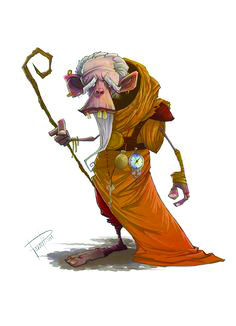
The old man touched him warmly on the shoulder and said, “Thank you for such kindness, young man,” and went on his way. Bachchu felt a change inside himself. The old man was not Baba, but he was still someone in need, and Bachchu remembered how good it felt to help others. From then on every face he saw, every bird and every tree, he knew might be Baba. He began to see the world in a very different way and treat it all with the reverence he had formerly reserved for his old teacher. His friends became suspicious of his actions, and gradually he stopped associating with them. He found a new job and became a valued member of the village.
A year later Bachchu’s old friends again visited Baba. They thanked him and asked him what he had done to turn the boy around so quickly.
Baba said, “It was not me. He changed himself. I simply gave him a new perspective, and I am sure that if anyone sees God in every creature, their whole world will change. And if everyone practices this, the whole world WILL change.”
The Universal Storyteller.